Woodpeckers eat more than wood. They eat insects (especially the ones inside wood), tree sap, acorns, nuts, seeds, fruit, suet at your feeder, and, contrary to a persistent myth, plain peanut butter without choking on it. This guide walks through the wild diet, the 6 most-attractive backyard feeder foods, and a species-by-species breakdown for the 7 woodpeckers most likely to visit a North American yard.
A note on naming: this article is about real food woodpeckers actually eat, not about the wood-eating cartoon caricature. Real woodpeckers are partly predatory (eating the insect larvae they extract from wood), partly granivorous (nuts and seeds), and partly nectarivorous (some species). The diet varies dramatically by species.
TL;DR
Woodpeckers eat insects (carpenter ants, beetle larvae, termites), tree sap, acorns, nuts, seeds, and fruit in the wild. At backyard feeders, the highest-attraction foods are suet (universal), whole peanuts, black-oil sunflower seed, peanut butter, mealworms, and fruit. Mount feeders on or near vertical surfaces at 5 to 10 feet. Match foods to species: Downy and Hairy prefer suet and seeds, Pileated wants suet and peanuts, Red-bellied likes nuts and fruit, Northern Flicker eats ants from the ground, Yellow-bellied Sapsucker drinks sap from holes it drills.
What woodpeckers eat in the wild
Insects (the foundation)
Wood-boring beetle larvae, carpenter ants, termites, and tree-dwelling insects make up the majority of most woodpecker diets, especially during spring and summer. Pileated Woodpeckers can consume thousands of carpenter ants in a single day, per Cornell Lab’s Pileated Woodpecker overview. The drilling sound homeowners often associate with woodpeckers is the bird excavating to reach insects inside dead wood, not eating the wood itself.
Tree sap (the sapsucker exception)
Yellow-bellied Sapsuckers drill horizontal rows of small holes (sap wells) in tree trunks and feed on the sap that wells up, plus the insects attracted to the sap. Cornell Lab’s Yellow-bellied Sapsucker overview covers the specialized behavior. Other woodpecker species occasionally drink sap from sapsucker wells but do not drill their own.
Acorns, nuts, and seeds
In fall, many woodpecker species shift to acorns, hickory nuts, beech nuts, and pine seeds. Red-headed Woodpeckers cache acorns in tree crevices for winter, similar to corvids. Red-bellied Woodpeckers are heavy nut eaters year-round.
Fruit and berries
Wild grapes, mulberries, serviceberry, holly berries, sumac, and juniper feed woodpeckers seasonally. Audubon’s regional bird-feeding coverage notes that fruit becomes critical in early spring before insects emerge and again in fall when nuts run low.
What woodpeckers eat at backyard feeders
Suet (the universal answer)
Suet is the single most-attractive backyard feeder food for woodpeckers across species. Plain rendered beef fat is the foundation; peanut-butter suet, bug suet (insect-mixed), and seed-mixed suet all work. Audubon’s Make Your Own Suet covers DIY alternatives if you do not want to buy commercial cakes.
A wire suet cage on a tree trunk or fence post at 5 to 10 feet is the standard setup. In summer above 80°F, use a no-melt formula to avoid rancidity. Audubon’s Guide to Winter Bird Feeding covers the cold-weather context where suet matters most.
Whole peanuts in the shell
Pileated and Red-bellied Woodpeckers in particular are drawn to whole peanuts in the shell. A wire peanut tube feeder or scatter on a platform feeder both work. Refresh every 4 to 7 days in humid weather to prevent Aspergillus mold (toxic to songbirds).
Black-oil sunflower seed
Downy, Hairy, and Red-bellied Woodpeckers all use sunflower from hopper or platform feeders. Small-port tube feeders typically exclude woodpecker beaks. Pair sunflower with suet for the highest-attraction combination.
Peanut butter (debunking the throat-sticking myth)
Plain natural peanut butter is safe for woodpeckers. The old “it sticks in their throats” claim is debunked by both Audubon and Cornell Lab. Use natural unsalted peanut butter with no xylitol (xylitol is toxic to wildlife). Spread directly on tree bark, fill drilled holes in a hanging log, or pack into pinecone crevices.
Mix with cornmeal if you want a less sticky texture (the classic Audubon formula is 1 part peanut butter to 5 parts cornmeal), though this is optional.
Mealworms
During nesting season, parent woodpeckers shuttle insects to nestlings. Live or dried mealworms in a platform feeder give parents an easy protein source. Cornell Lab’s About Suet, Mealworms, and Other Bird Foods covers the broader mealworm context for backyard birds.
Fruit and jelly
Halved oranges, apple slices, and small dishes of grape jelly attract Red-bellied Woodpeckers and Northern Flickers in particular. The same setup that works for our oriole feeder draws some woodpeckers too, especially during late summer and fall.
The 7 backyard woodpecker species and what each prefers
The 7 woodpecker species most likely to visit US backyards differ meaningfully in diet and feeder preference. Match foods to the species you actually see.
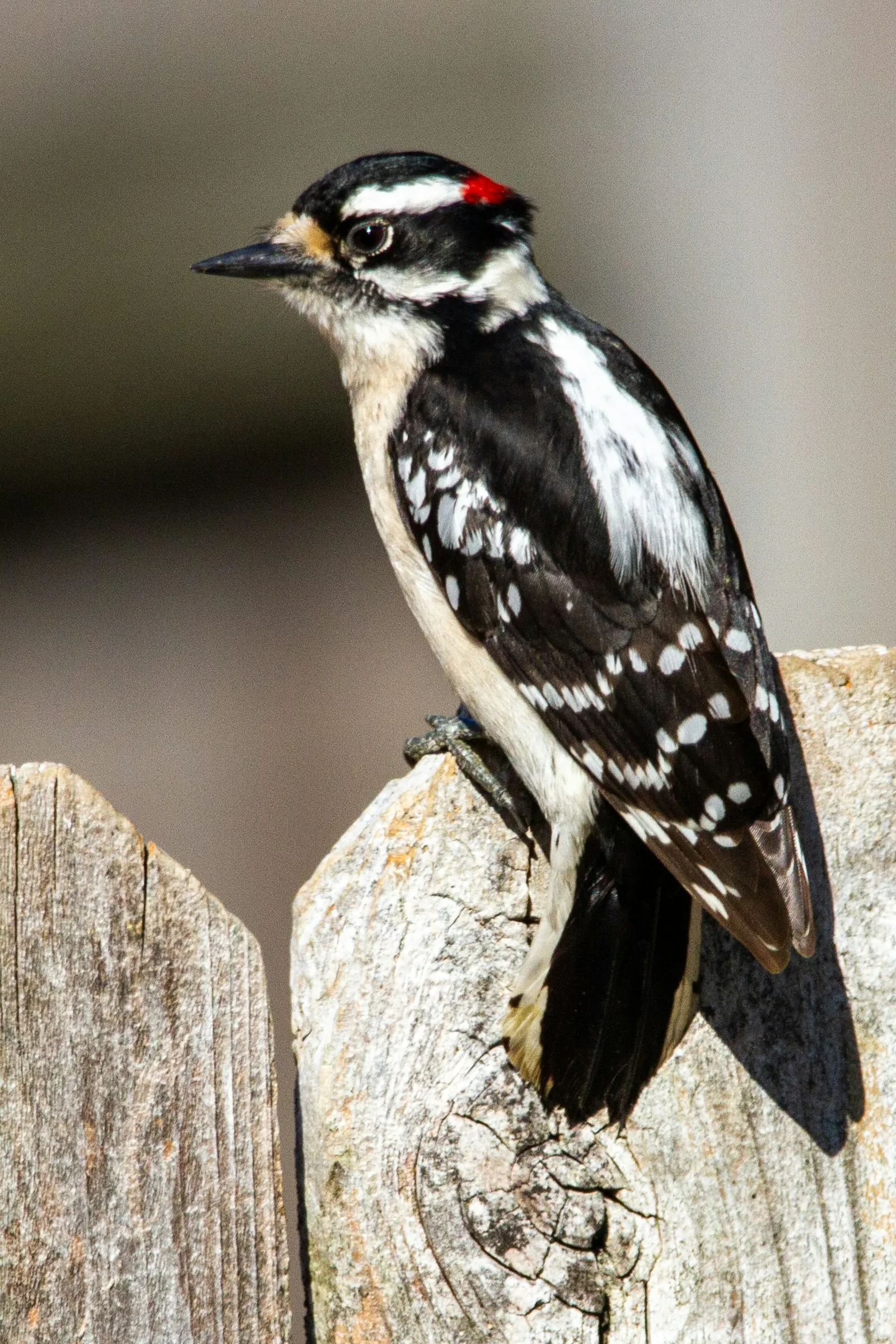
Downy Woodpecker (the easiest backyard species)
The smallest North American woodpecker, found across nearly the entire US. Diet: insects (about 75 percent of natural diet), with seeds, berries, and acorns rounding it out. At feeders: suet, peanut butter, black-oil sunflower seed, mealworms. Cornell Lab’s Downy Woodpecker overview covers the full natural history.
Hairy Woodpecker (the Downy’s bigger cousin)
Looks identical to Downy but larger with a longer bill. Range overlaps Downy’s almost completely. Diet: more insect-heavy than Downy (about 80 percent), prefers wood-boring beetle larvae. At feeders: same as Downy, suet, peanuts, sunflower. Cornell Lab’s Hairy Woodpecker overview covers the species.
Red-bellied Woodpecker (the eastern omnivore)
The “red-bellied” name is misleading: the obvious red is on the head and nape, with only a faint pink wash on the lower belly that gives the species its name. Found across the eastern half of the US. Diet: roughly equal parts insects, nuts, and fruit. At feeders: suet, whole peanuts, sunflower, halved oranges, jelly. Cornell Lab’s Red-bellied Woodpecker overview covers the species.
Pileated Woodpecker (the crow-sized giant)
The largest North American woodpecker, nearly the size of a crow, with a flaming red crest. Found in mature forests across the East and Pacific Northwest. Diet: carpenter ants are the staple, plus wood-boring beetle larvae and berries. Audubon and Cornell Lab note that a single Pileated can consume thousands of ants per day, making them legitimate pest controllers. At feeders: suet (sometimes), whole peanuts, large peanut blocks. Cornell Lab’s Pileated Woodpecker overview covers the species.
Northern Flicker (the ground forager)
A large brown-and-spotted woodpecker that, unusually, forages on the ground for ants more than any other backyard woodpecker. Cornell Lab’s Northern Flicker overview notes ants make up the majority of summer diet. At feeders: less common than other woodpeckers, but takes suet, mealworms, and occasionally sunflower seed.
Red-headed Woodpecker (declining, special attention)
Striking entirely-red head with white belly and black-and-white wings. Eastern US, declining population. Diet: insects, nuts (especially acorns, which they cache), and small vertebrates including occasionally other birds’ eggs. At feeders: suet, peanuts, sunflower, mealworms. Cornell Lab’s Red-headed Woodpecker overview covers the species and conservation status.
Yellow-bellied Sapsucker (the sap-well specialist)
A small woodpecker found in the eastern US and Canada (some western populations of the closely-related Red-naped Sapsucker overlap). Diet: tree sap from sap wells the bird drills, plus the insects attracted to the sap. Sapsuckers can damage some ornamental trees with extensive sap-well drilling. At feeders: occasionally takes suet, but the species is primarily a sap specialist that does not use feeders heavily. Cornell Lab’s Yellow-bellied Sapsucker overview covers the species.
Summer vs winter diet shifts
Woodpeckers shift food sources seasonally. Spring and summer: insects dominate. Wood-boring beetle larvae, carpenter ants, termites, caterpillars, and other arthropods make up 60 to 90 percent of summer diets depending on species. Backyard feeders matter less in summer because wild insects are abundant.
Fall and winter: woodpeckers shift to seeds, nuts, suet, and any remaining fruit. Insects either migrate underground or hide deeper in wood, and the birds compensate with calorie-dense alternatives. Backyard feeders matter most in winter, especially in regions with sub-freezing temperatures. Mass Audubon’s Woodpeckers page covers the seasonal shifts in the Northeast.
A practical implication: keep suet feeders out year-round but expect heaviest use from November through March in most US regions. Audubon’s 11 Tips for Feeding Backyard Birds covers broader seasonal-feeding patterns across species.
Do woodpeckers eat wood?
No. The “woodpeckers eat wood” idea is one of the most persistent misunderstandings about the family. Woodpeckers drill into wood to reach the insects living inside, not to eat the wood. The two main reasons a woodpecker drills:
- Foraging. Wood-boring beetle larvae, carpenter ants, termites, and other insects live inside dead or rotting wood. Woodpeckers excavate to extract them.
- Nesting. Most species drill their own nest cavities in dead trees or dead branches. After the woodpeckers leave, the cavities become valuable real estate for chickadees, nuthatches, titmice, screech owls, wood ducks, and other secondary-cavity nesters.
Healthy live trees are rarely damaged by woodpecker activity. Drilling on house siding is almost always for territorial drumming (loud surface tapping during spring) rather than feeding or nesting; reflective tape or owl decoys with moving parts solve the rare siding-damage problem.
Are woodpeckers good for your yard?
Yes, in nearly every case. The 3 main benefits:
Pest control at scale. A single Pileated Woodpecker can eat thousands of carpenter ants per day. Northern Flickers eat more ants than any other North American bird. If your yard has a carpenter-ant or termite problem in dead wood, having woodpeckers is a net positive.
Cavity creation for other species. Old woodpecker holes become nest sites for chickadees, nuthatches, bluebirds (our how to attract bluebirds guide covers the value of nest cavities), screech owls, wood ducks, and other species that cannot drill their own.
Forest ecosystem health. Woodpeckers disperse acorn and nut seeds, control bark-beetle outbreaks, and indicate healthy mature-forest conditions.
The minor downsides: occasional spring drumming on metal gutters or wood siding (annoying but rarely damaging), and Yellow-bellied Sapsucker can stress ornamental trees with extensive sap-well drilling. Both are manageable with simple deterrents.
What to skip
Bread, crackers, cake. Low-nutrition fillers that occupy crop space without providing calories or protein.
Peanut butter with xylitol. Xylitol is toxic to many wildlife species. Read the label.
Cheap mixed seed (millet-heavy). Woodpeckers ignore millet. Buy single-ingredient food: black-oil sunflower, whole peanuts, plain suet.
Suet in 80°F+ heat without no-melt formula. Regular beef suet goes rancid in heat. Use no-melt summer suet from May through September in most US regions.
Removing woodpeckers. Native woodpeckers are protected under the US Migratory Bird Treaty Act. Lethal control or trapping is illegal without a federal permit. Use deterrents (reflective tape, owl decoys with moving parts) for siding/gutter problems.
Leaving suet feeders dirty. Project FeederWatch’s Sick Birds and Bird Diseases documents salmonellosis and conjunctivitis outbreaks tied to dirty feeders. Scrub suet cages weekly with 9:1 water-to-vinegar.
FAQ
What is a woodpecker’s favorite food? Suet is the single most-attractive food for backyard woodpeckers across all species. In the wild, individual woodpecker species have different favorites: Pileated Woodpeckers prefer carpenter ants and wood-boring beetle larvae extracted from dead wood; Northern Flickers eat ants from the ground; Red-bellied Woodpeckers prefer nuts, fruit, and insects in roughly equal measure; Yellow-bellied Sapsuckers drink tree sap from sap wells they drill. At a backyard feeder, suet beats every other food.
Do woodpeckers eat wood? No, woodpeckers do not eat wood itself. They drill into wood to reach wood-boring insect larvae (especially carpenter ant larvae, beetle larvae, and termites) that live inside dead or rotting branches and tree trunks. The drilling sound that homeowners often mistake for wood-eating is actually woodpeckers extracting insects from the wood. Healthy live trees are rarely damaged; woodpeckers strongly prefer dead wood where the insects they want actually live.
Can woodpeckers eat peanut butter? Yes. Plain natural peanut butter is safe for woodpeckers, contrary to the persistent myth that it sticks in birds’ throats. Audubon and Cornell Lab both confirm peanut butter is fine. Use unsalted natural peanut butter with no added sugar and no xylitol (which is toxic to wildlife). Spread directly on a tree trunk, fill drilled holes in a hanging log, or stuff into pinecone crevices. Mix with cornmeal if you want a less sticky texture, though that is not strictly necessary.
Do woodpeckers eat at bird feeders? Yes, most backyard woodpecker species readily use feeders. Suet in a wire cage feeder is the highest-attraction option. Peanut tube feeders and platform feeders with whole peanuts, sunflower seed, or mealworms also work well. Woodpeckers cling to vertical surfaces rather than perching, so look for feeders designed with vertical wire mesh or that hang against a flat surface like a tree trunk or fence post. Mount at 5 to 10 feet.
What do woodpeckers eat in winter? In winter, woodpeckers shift from insect-heavy summer diets to seeds, nuts, suet, and any remaining berries. Insects become scarce or hidden deeper in wood, so backyard feeders matter more in winter than in summer. Suet, peanuts, and black-oil sunflower seed are the three highest-impact winter foods. Pileated Woodpeckers continue chiseling into wood for overwintering carpenter ants and beetle larvae. Northern Flickers head south for migration in most of their range; the ones that stay through winter rely heavily on suet and fruit.
Is it good to have woodpeckers in your yard? Yes, in nearly every case. Woodpeckers eat enormous quantities of pest insects: a single Pileated Woodpecker can consume thousands of carpenter ants per day, and Northern Flickers are the top ant-eating bird in North America. They also disperse acorn and nut seeds, dig nest cavities that other species (chickadees, nuthatches, screech owls, wood ducks) later use, and act as part of a healthy forest ecosystem. The only minor downside is occasional drumming on house siding or gutters during spring territorial displays, which is annoying but rarely causes real damage to sound wood. Repellents and visual deterrents (reflective tape, owl decoys with moving parts) handle the rare problem.
What to do this week
If you have woodpeckers passing through and want them to stay:
- Buy or build a wire suet cage feeder and hang it on a tree trunk or sturdy fence post at 5 to 10 feet.
- Use plain rendered suet in cool weather or a no-melt formula in summer. Replace every 1 to 2 weeks.
- Add a whole-peanut tube feeder 10 to 15 feet away for Pileated and Red-bellied Woodpeckers.
- Skip cheap millet-heavy seed mixes; use straight black-oil sunflower or whole peanuts.
If you do not have woodpeckers visiting and want to attract them:
- Confirm the species are in your area via Cornell Lab’s eBird abundance maps.
- Put up suet plus peanuts and wait 2 to 4 weeks. Woodpeckers find new feeders within their normal foraging range relatively quickly compared to other species because they actively prospect.
- Leave some dead wood (a dead branch in a tree, a small standing snag) if your yard allows. This is the single most-attractive habitat feature for woodpeckers because it provides both food (insects) and potential nest sites.
For the broader feeder-station strategy, our how to attract birds to a bird feeder pillar covers the universal setup. The bird feeder for blue jays guide and oriole feeder article cover sister species-specific feeder approaches. Our DIY bluebird feeder guide covers a similar DIY-on-a-fence-post setup. Our companion diet guides cover what robins eat, what mourning doves eat, and what blue jays eat, more species whose feeding needs reshape how you stock a yard. The how long do birds live synthesis pillar covers the broader backyard-bird welfare context, including the threats (cats, windows, dirty feeders) that affect woodpecker longevity as much as any other species.
Woodpeckers are among the most rewarding backyard species to attract: striking-looking, ecologically valuable, and easy to feed once you have a suet cage on a tree trunk and a basic understanding of what they actually eat.