What do orioles eat? Insects, fruit, and nectar, not seeds. Orioles are among the most colorful birds to visit a backyard, and the way to attract them has nothing to do with the seed feeder that draws cardinals and finches. They want oranges, jelly, nectar, and insects. This guide covers the real oriole diet by season and by species, what to offer at a feeder, and what to skip, all grounded in Cornell Lab of Ornithology research.
TL;DR
- Orioles eat insects, fruit, and nectar (Cornell Lab), and essentially no seed.
- The diet shifts by season: mostly insects in summer for protein, more nectar and ripe fruit in spring and fall to fuel migration.
- At feeders they take oranges, grape jelly, and sugar-water nectar, plus mealworms.
- All three common species (Baltimore, Bullock’s, Orchard) follow the insect-fruit-nectar pattern.
- Baby orioles eat insects, the protein their growing bodies need.
- Jelly only in moderation: too much can soil an oriole’s feathers (Cornell Lab).
What do orioles eat in the wild?
Orioles forage in the leafy canopy of trees, gleaning insects from leaves and branches and seeking out ripe fruit and flower nectar. They are canopy birds and not seed eaters, which is the single most important fact about feeding them.
The seasonal diet: insects, fruit, and nectar
Per Cornell Lab’s All About Birds, “Baltimore Orioles eat insects, fruit, and nectar. The proportion of each food varies by season.” In summer, while breeding and feeding their young, much of the diet is insects, which supply the protein nestlings need to grow. In spring and fall, nectar and ripe fruit make up more of the diet, because those sugary foods are readily converted into the fat that fuels migration.
The insect list is broad: beetles, crickets, grasshoppers, moths, flies, spiders, and snails, plus many pest species like tent caterpillars, gypsy moth caterpillars, and fall webworms. An oriole working through a tent-caterpillar nest is doing your trees a real favor.
Do orioles eat seeds? (why they skip seed feeders)
No. Orioles are built for fruit, nectar, and insects, not for cracking hard seeds, so they ignore the sunflower and mixed-seed feeders that pull in cardinals and finches. This puts them alongside the robin as a bird you attract with fruit and protein, not seed. If your feeders are all seed, you will not see an oriole no matter how long you wait.
Do the three oriole species eat the same things?
Mostly yes, with regional and technique differences. North America has three widespread breeding orioles, and all three run on the same insect-fruit-nectar diet.
Baltimore Oriole
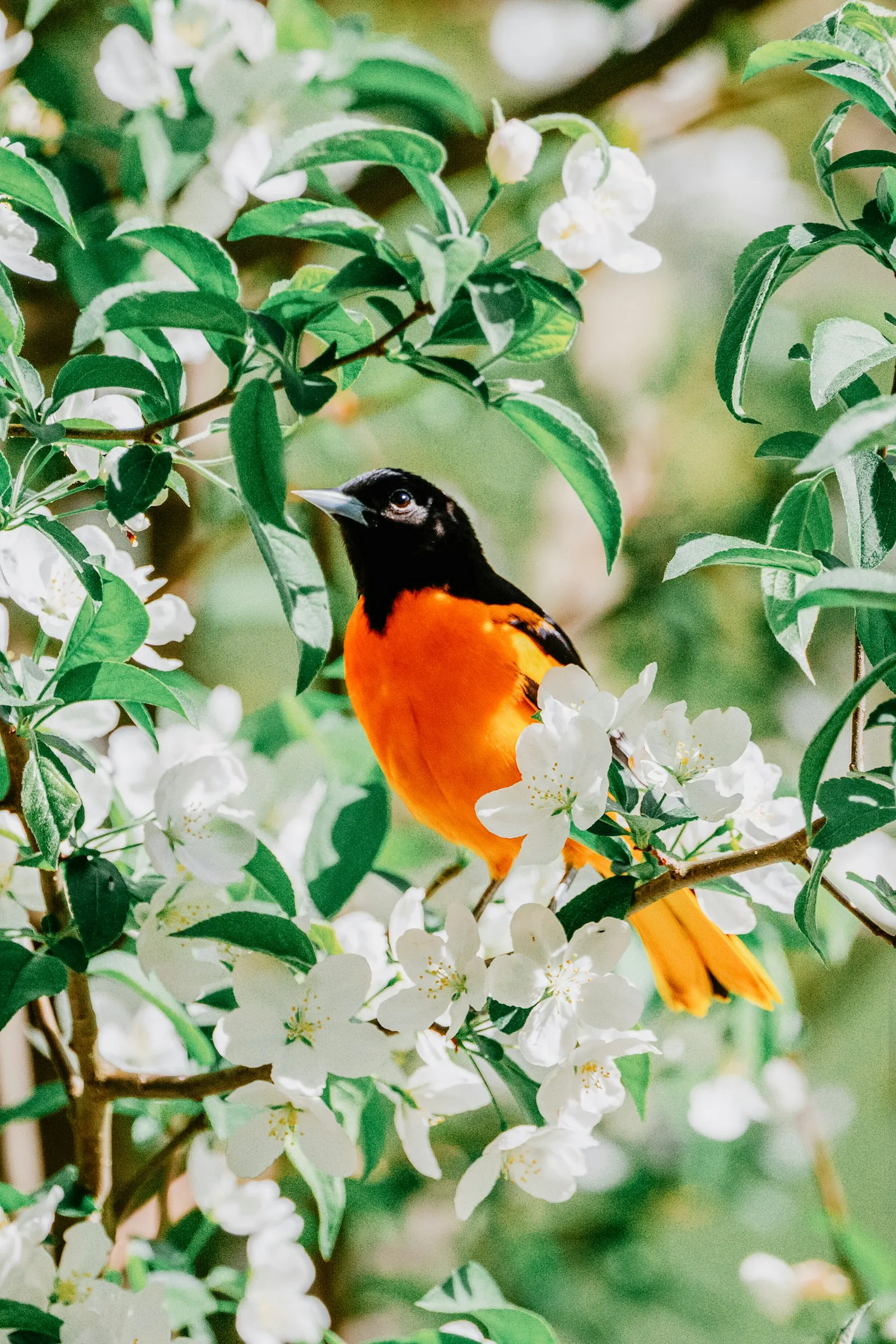
The Baltimore Oriole is the familiar orange-and-black oriole of eastern and central North America. Its diet is the seasonal mix above: pest caterpillars and other insects in summer, nectar and ripe fruit in spring and fall (Cornell Lab). It readily comes to backyard feeders for oranges, jelly, and nectar.
Bullock’s Oriole
The Bullock’s Oriole is the western counterpart. Per Cornell Lab, it eats insects and other arthropods along with fruit and nectar, and uses a technique called “gaping”: it thrusts its closed bill into fruit or a tough caterpillar, then pries the bill open to lap up the juices. Before eating honeybees, a Bullock’s Oriole will even remove and drop the stinger.
Orchard Oriole
The Orchard Oriole is the smallest North American oriole and the most insect-focused. Cornell Lab notes it eats “mostly insects and other arthropods, along with some fruit and nectar,” gleaning caterpillars, grasshoppers, crickets, beetles, and spiders from foliage. It drinks nectar from flowers and even from hummingbird feeders, and shifts to mostly fruit (mulberries, chokecherries) just before fall migration.
What do orioles eat at feeders?
Orioles are one of the great backyard feeder birds if you offer the right food. Cornell Lab’s backyard guidance is specific: cut oranges in half and hang them from trees, offer oriole feeders filled with sugar water to supplement natural flower nectar, and “put out small amounts of jelly to attract these nectar-eaters.”
- Oranges, halved and hung cut-side out, are the classic first food and the fastest way to catch a passing oriole’s eye.
- Grape jelly, in small amounts, is a strong draw (more on the welfare limit below).
- Nectar: sugar water mixed 4 parts water to 1 part sugar, no red dye, in an oriole feeder with larger ports than a hummingbird feeder. It is the same recipe as our hummingbird nectar recipe, just served from an oriole feeder.
- Mealworms, live or dried, are a protein bonus, especially useful when adults are feeding fledglings in midsummer.
For the feeder styles, timing by region, and full setup, see our companion guide to the oriole feeder and where to hang an oriole feeder. This article is about the food itself.
Oriole feeder-food cheat sheet
| Food | Will orioles eat it? | Notes |
|---|---|---|
| Orange halves | Yes | The classic first food; hang cut-side out |
| Grape jelly | Yes, in moderation | Small amounts only; too much soils feathers |
| Nectar (4:1 sugar water) | Yes | Oriole feeder, larger ports, no red dye |
| Mealworms (live or dried) | Yes | Protein bonus, best in breeding season |
| Fresh fruit (grapes, berries) | Yes | Matches the wild fruit diet |
| Mixed birdseed / sunflower | No | Orioles are not seed eaters |
| Suet (plain) | Rarely | Not a primary oriole food |
What do orioles eat in winter?
For most of the country, the answer is that there are no orioles to feed in winter. Baltimore, Bullock’s, and Orchard Orioles are long-distance migrants that leave the United States for Mexico and Central America, where they spend the winter eating fruit and nectar in gardens, flowering trees, and shade-grown coffee plantations (Cornell Lab).
A small number of Baltimore Orioles are known to overwinter along the Gulf Coast and the Southeast, where they rely on fruit, feeder jelly, and nectar. But the real oriole feeding season is spring through late summer. Put your feeders out ahead of spring arrival, which is what our oriole feeder guide covers by region.
What do baby orioles eat?
Insects, almost entirely. As Cornell Lab notes, during the breeding season “much of the diet consists of insects, which are rich in the proteins needed for growth.” Growing chicks need the protein that insects supply and that fruit and nectar cannot, so the summer diet skews heavily to insects while parents are raising young. This is why a pesticide-free yard with healthy insect life matters as much as any feeder. For the broader picture of how young birds are fed, see our guide on what fledgling birds eat.
What not to feed orioles
- Do not offer seed and expect orioles. They will not eat it; use oranges, jelly, and nectar.
- Do not overdo the jelly. Cornell Lab warns not to put out so much that it risks soiling the birds’ feathers. A tablespoon at a time, refreshed daily, is plenty. Low-sugar or natural fruit spreads are gentler than heavily sweetened jelly.
- Never use red dye in nectar. It is unnecessary and potentially harmful; the feeder’s color attracts orioles, not the liquid’s.
- Do not let fruit or nectar spoil. Orange halves mold and nectar ferments in a few days, especially in heat. Refresh often and clean feeders, the same hygiene rule as our hummingbird feeder cleaning guidance.
- Skip bread and processed food. Empty calories with no value for a fruit-and-insect eater.
FAQ
These answers are also marked up as FAQ structured data on the page.
What do orioles eat at feeders? Oranges, grape jelly, and sugar-water nectar, plus mealworms. Cornell recommends halved oranges, oriole feeders with sugar water, and small amounts of jelly. Orioles do not eat seed.
Do orioles eat seeds? No. Orioles eat insects, fruit, and nectar, and ignore seed feeders. Offer oranges, jelly, and nectar instead.
What do orioles eat in winter? Most migrate to Mexico and Central America and eat fruit and nectar there. A few overwinter along the Gulf Coast on fruit and feeders; elsewhere the feeding season is spring through summer.
Will orioles eat dried mealworms? Yes, live or dried, especially in breeding season when they need protein for nestlings. Offer them near your orange or jelly feeder.
Will orioles eat strawberry jelly? Grape jelly is the classic, but orioles will take other fruit jellies. Offer only small amounts, since too much jelly can soil their feathers.
What do orioles eat at night? Nothing. Orioles are diurnal and roost at night. They feed by day, most actively in early morning and late afternoon.
What to do this week
If orioles are in your area (spring through summer), hang a halved orange and a small dish of grape jelly from a branch or shepherd’s hook within sight of tall trees, and add an oriole nectar feeder with 4:1 sugar water. Refresh the fruit and jelly every couple of days and keep the jelly portion small. If you are not sure whether orioles have arrived yet, the timing is in our oriole feeder guide, and where to hang an oriole feeder covers placement. Get the food out before spring migration peaks, and the first scouts will find it.
Sources
- Cornell Lab of Ornithology, All About Birds: Baltimore Oriole Life History (seasonal insect-fruit-nectar diet, pest caterpillars)
- Cornell Lab of Ornithology, All About Birds: Baltimore Oriole Overview (backyard feeding: oranges, sugar water, jelly-in-moderation)
- Cornell Lab of Ornithology, All About Birds: Bullock’s Oriole Life History (western species, gaping technique)
- Cornell Lab of Ornithology, All About Birds: Orchard Oriole Life History (insect-focused, hummingbird feeders, fruit before migration)