If you live where orioles migrate through, you have a 6 to 8 week window every spring when one of the brightest birds in North America will come down to a feeder in your yard. Most readers miss the window by putting the feeder out too late, picking the wrong food, or hanging it where orioles will not look. This guide walks through the 5 oriole-feeder styles, what to fill them with, the zone-by-zone timing, and the jelly welfare rule most other guides skip.
TL;DR
Pick a feeder with orange or yellow color. Hang it 6 to 10 feet up near tall trees. Fill it with halved oranges, 1 tablespoon of grape jelly per day, and 4:1 sugar-water nectar (no red dye). Put it out 1 to 2 weeks before peak arrival in your zone (late March Gulf Coast, mid-April Mid-Atlantic, early May Great Lakes, mid-May Upper Midwest). Refresh daily, clean weekly with 9:1 water-vinegar, and take it down 2 weeks after the last sighting in fall.
The 5 oriole feeder styles (and which to buy first)
The five common designs each solve a different food problem. If you do not know which orioles are in your area, start with an orange-half or combo feeder. Birds&Blooms documents that a combo style (orange-half plus jelly cup) is the highest-attraction single feeder if you only want to put one out.
Orange-half feeders
A horizontal prong or vertical nail holds an orange cut in half, cut side up. Cheapest and most-attractive option for the first season. Audubon’s Make an Orange Feeder for Orioles walks through a DIY version on a tree branch with a finishing nail; you can also buy a $10 to $20 commercial unit from any backyard-bird retailer. Replace the orange every 2 days; fermenting fruit attracts wasps and turns birds away.
Jelly cup feeders
A small dish (1 to 2 ounce capacity) holds grape jelly. The capacity is intentionally small to enforce the welfare rule: orioles should not have unlimited jelly. Audubon’s Guide to Attracting Hummingbirds and Orioles and Guide to Luring Warblers, Tanagers, Orioles, and Grosbeaks to Your Yard both flag the same constraint. 1 tablespoon per day, refreshed daily.
Nectar (oriole saucer) feeders
A saucer-style nectar feeder with larger feeding ports than a hummingbird unit. Fill with 4:1 sugar-water, the same recipe in our hummingbird nectar recipe. No red dye. Refresh every 2 to 3 days in mild weather, daily in heat. Orioles tend to use a saucer-style design with a perch over a vertical tube; both work, but the saucer is easier to clean.
Fruit dish and clementine feeders
A shallow horizontal dish or clementine-half cradle for cut fruit (apple slices, grapes, melon chunks, or whole clementine halves). Best for late spring and early summer when migrants have just arrived and want variety. Mealworms can go in the same dish if a parent is feeding fledglings. Orioles are not the only birds drawn to fruit and jelly; woodpeckers eat oranges and grape jelly too, especially Red-bellied Woodpeckers and Northern Flickers, so an orange-half feeder often pulls in both.
Mesh sock and combo feeders
Combination units that bundle 2 or 3 styles (orange prong + jelly cup + nectar reservoir) on one rig. Slightly more expensive but the highest attraction per square foot of yard. If you have one feeder pole and want the broadest oriole appeal, this is the buy.
We have a similar pillar piece on hummingbird feeders covering tier breakdowns; the same buying logic applies to orioles, except commercial oriole feeders are mostly in the $15 to $45 range (no $200 designer-glass class exists for this niche).
What to feed orioles (and the welfare math on jelly)
Cornell Lab’s Here’s What to Feed Your Summer Bird Feeder Visitors and Audubon’s 11 Tips for Feeding Backyard Birds cover the basic menu, and our guide to what orioles eat breaks down the full diet by season and species. Here is the operating detail:
Oranges
Half an orange, cut side up, on a prong or nail. Use a real orange (any variety; Valencia and navel both work). The bird drinks the juice and pecks at the pulp; a single half typically lasts 2 to 3 days before drying out or fermenting. In humid weather, swap daily. In dry weather, swap every 2 days.
Grape jelly (the 1-tablespoon rule)
Grape jelly is the strongest attractor after oranges. It is also the single biggest welfare concern in oriole feeding. Audubon’s guidance: put out small amounts only. Unlimited jelly soils feathers (orioles stick their faces into the dish and walk off with jelly on their chests and crowns), may disrupt mineral balance, and is especially problematic for fledglings learning to forage.
The safe protocol:
- 1 tablespoon per day per feeder, refreshed daily.
- Real grape jelly, not high-fructose corn syrup as the first ingredient. Welch’s Grape Jelly is the most common pick; store-brand grape jelly is fine if the label is sugar plus grape juice.
- In a shallow dish where birds can reach the bottom without dunking their heads.
- Take jelly feeders down at the first sign of feather-staining on visiting birds.
Nectar (4:1 sugar:water, no red dye)
The recipe is the same as for hummingbirds: 4 parts water to 1 part white sugar. Boil briefly to dissolve, cool fully, fill. No red dye, no honey, no brown sugar, no artificial sweeteners. Refresh every 2 to 3 days in mild weather, daily in heat. Our hummingbird nectar recipe covers the full ratio and no-red-dye reasoning; orioles use the identical recipe with a larger-port feeder. Like hummingbirds, orioles take far more than sugar water in the wild (fruit, nectar, and a lot of insects); our guide to what hummingbirds eat explains the fuel-plus-protein pattern both birds follow.
Mealworms and suet
Less common but useful in mid-summer when orioles are feeding fledglings. Dried mealworms in a shallow dish, or a suet-nectar block in a cage feeder, both work. Skip pure beef-fat suet in summer heat; it melts and goes rancid.
When to put out oriole feeders (by zone)
This is the single biggest reason yards do not get orioles: the feeder went out a week after the first scouts already passed through. Put feeders out 1 to 2 weeks before peak arrival.
| Region | Peak arrival | Put feeders out by |
|---|---|---|
| Gulf Coast, Florida, Southeast (zones 8 to 10) | Late March to early April | Mid-March |
| Lower Midwest, Mid-Atlantic (zones 6 to 7) | Mid to late April | Early April |
| Great Lakes, New England (zones 4 to 5) | Early to mid-May | Late April |
| Upper Midwest, Northern Plains (zones 3 to 4) | Mid to late May | Early May |
| Pacific Northwest (Bullock’s range) | Late April to mid-May | Mid-April |
| California, Southwest (Bullock’s, Hooded) | Late March to April | Mid-March |
Cornell Lab’s Baltimore Oriole range map shows the migration timing in fine detail; the equivalents for Bullock’s Oriole and Orchard Oriole cover the western and southern populations.
When to take feeders down in fall
Take feeders down 2 weeks after your last confirmed sighting. Typical fall departure:
- Upper Midwest, New England: mid-August
- Lower Midwest, Mid-Atlantic: early to mid-September
- Southeast, Gulf Coast: October to early November
- Florida and South Texas: some Baltimore Orioles overwinter
Leaving feeders up later does not delay migration. Orioles leave on photoperiod (day length) cues, not food availability. Empty, clean, and store the feeder once they are gone; fermenting jelly and nectar in fall feeders attract wasps and can sicken late migrants.
Where to place an oriole feeder
Orioles forage in the canopy. They scan for food from 30 to 60 feet up while moving through trees. A feeder placed 3 feet off the ground in an open lawn might as well be invisible.
Height (6 to 10 feet off the ground)
Hang an oriole feeder 6 to 10 feet off the ground. Orioles forage high in the tree canopy and will not consistently drop to a feeder placed lower than about 5 feet in open lawn. Mount it on a sturdy branch, shepherd’s hook, or pole, and keep it visible from above. Higher than 10 feet is fine; lower is not.
A hummingbird-style 4-foot stake or low railing usually fails for orioles. What matters is visibility from above: a passing oriole scanning from 30 to 60 feet up needs to spot the bright orange or yellow signals on the feeder. For the full placement picture (exact location, distance from trees and windows, and squirrel-proofing), see our dedicated guide on where to hang an oriole feeder.
Color and visibility
Bright orange or yellow plastic on the feeder itself plus real orange halves alongside is the strongest signal. For the first 2 weeks after putting the feeder out, tie an orange flagging-tape ribbon nearby to amplify the visual signal. After orioles establish, the ribbon is no longer needed; they remember the spot.
Distance from other feeders
Place the oriole feeder 15 to 30 feet from your main seed and hummingbird feeders. Far enough that fallen seed and squirrel traffic do not foul the oriole station, close enough that yard-active birds notice it. If you already have a hummingbird-attracting yard, the same 6 to 10 foot canopy-edge placement that works for hummingbirds works for orioles.
Distance from trunks (squirrel-proofing)
At least 10 feet from any climbable trunk or pole. Squirrels eat oranges and steal jelly. We cover the full squirrel-proofing math in our keep squirrels out of bird feeders guide and compare the best squirrel-proof bird feeders separately; the 5-7-9 rule applies to oriole feeders the same way it applies to seed feeders.
The 3 oriole species you might see
Three orioles regularly visit US backyard feeders. Knowing which one you have helps you set realistic expectations for timing and feeder use.
Baltimore Oriole (eastern US)
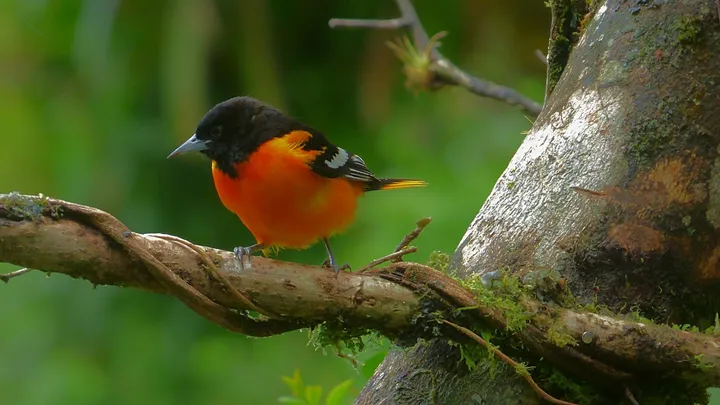
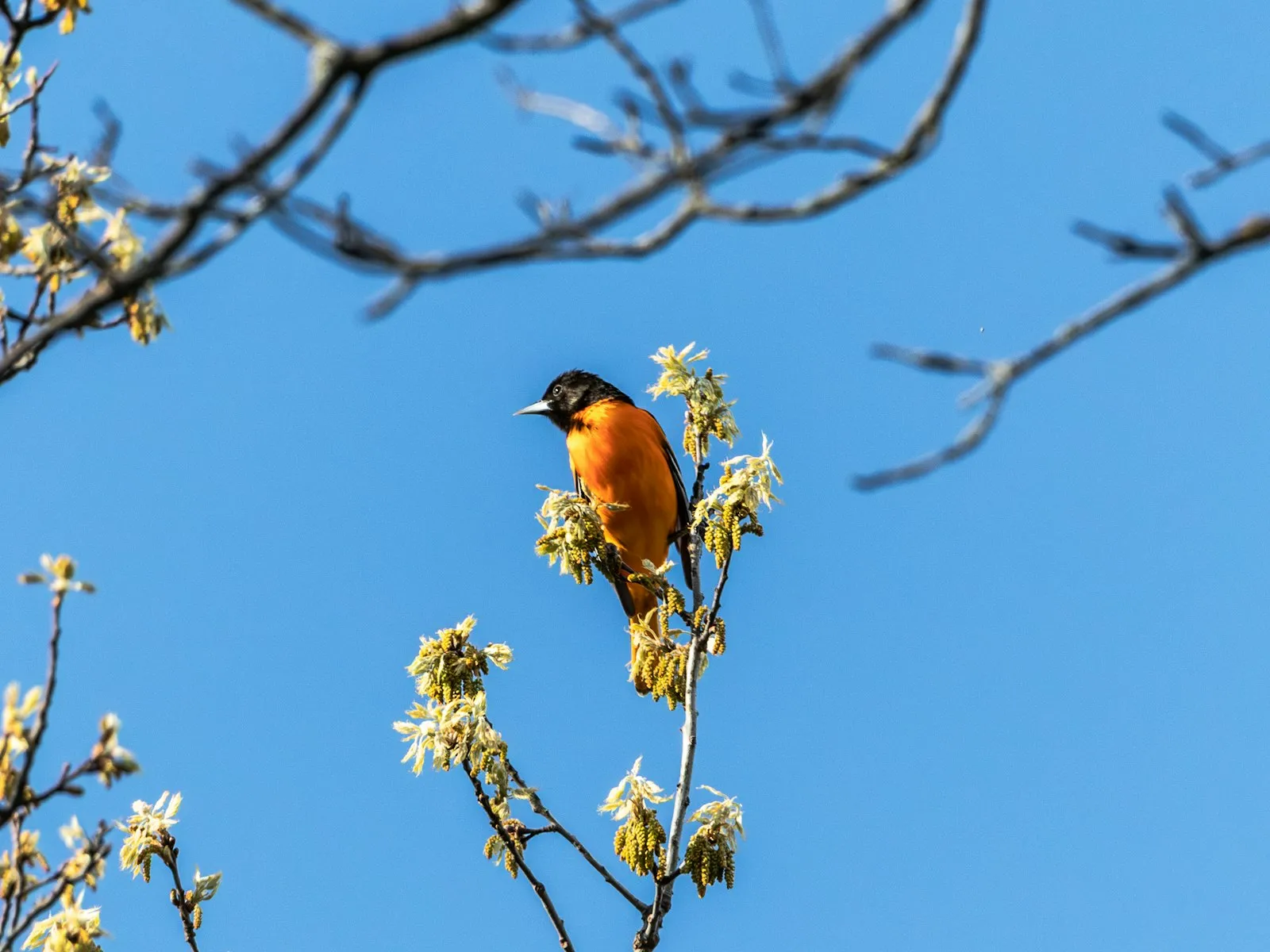
The classic orange-and-black oriole, breeding from Texas to Maine and across the Great Lakes into Canada. Males are flame orange below and black above with white wing bars; females are duller yellow-olive. Cornell Lab’s Baltimore Oriole overview covers the range, breeding behavior, and full ID. Audubon’s 10 Fun Facts About the Baltimore Oriole adds context for the casual reader.
Bullock’s Oriole (western US)
The western counterpart, replacing Baltimore Oriole roughly west of the Great Plains. Males have an orange face with a black eye-line and crown, large white wing patches, and an orange tail. The two species hybridize where their ranges meet (eastern Colorado, Nebraska, the Dakotas). Cornell Lab’s Bullock’s Oriole overview has the range map and migration timing.
Orchard Oriole (southern and central US)
Smaller than the other two, with chestnut (not orange) underparts and a black hood. Breeds from Texas and Florida north to the Great Lakes, often alongside Baltimore Orioles in the same yards. Uses the same feeders but is shorter-distance migrant and arrives a week or two later in most zones. Cornell Lab’s Orchard Oriole overview covers the species.
A fourth species (Hooded Oriole) reaches the desert Southwest and Southern California; if you live in San Diego or Tucson, you may also see Hooded and Scott’s Orioles at feeders.
Why orioles aren’t coming to your feeder
Four common causes, in this order:
1. The feeder went up too late. Migrants pass through fast. If the first scouts arrived a week ago and your feeder went up yesterday, the regular visitors are already eating somewhere else and may not switch. Put feeders out 1 to 2 weeks before peak arrival next year.
2. It is the wrong color. Plain green or brown feeders pull orioles in poorly. Orange and yellow feeders pull them in well. Add real orange halves alongside for the first 2 weeks.
3. It is too low or in too open a spot. Hang at 6 to 10 feet, near a tall tree. Orioles will not come down to an exposed 3-foot stake in the middle of a lawn.
4. The food is wrong or stale. Fermented oranges, crystallized jelly, and 4-day-old nectar all repel orioles. Fresh-everything for the first 2 weeks of a new setup.
Like our bird feeder discovery rule, give a new oriole feeder 2 to 3 weeks of consistent fresh food before declaring it a failure. Birds need time to find new food sources, and once they do, they remember the spot year-over-year.
DIY oriole feeders (3 fast builds)
If you want to put a feeder out today without buying anything:
1. Orange-half on a nail. Hammer a galvanized finishing nail into a tree branch at 6 to 8 feet, leaving 2 inches sticking out. Push half an orange (cut side up) onto the nail. Done. The original Audubon design.
2. Mason jar nectar feeder. Buy a $5 commercial mason-jar-fits oriole base (saucer with feeding ports), screw it onto any standard wide-mouth pint jar, fill with 4:1 nectar, hang. If you do not want to buy the base, a thin glass dish wired beneath a hanging branch with sugar-water in it also works; messier but free.
3. Orange wreath / fruit dish. Wire-loop a circle of orange slices around a wreath frame, hang from a tree. BirdsAndBlooms has the original photo tutorial; if you want jelly too, put a small ramekin in the center.
If you build something that holds jelly, remember the 1-tablespoon rule. A bowl bigger than 2 ounces is a welfare problem, not a feature. If you enjoy building feeders, our DIY bluebird feeder guide is another afternoon project that uses the same scrap-materials approach.
What to skip
Honey, brown sugar, agave, artificial sweeteners. Honey grows fatal botulism in nectar. Brown sugar has too much iron. Agave does not match wild nectar chemistry. Artificial sweeteners provide zero calories for birds that need calories to migrate. Use plain white table sugar only.
Red dye. Has no benefit, may harm. Orioles find the feeder via shape and color of the feeder body, not the nectar color.
Unlimited grape jelly. Welfare risk. 1 tablespoon per day per feeder, refreshed daily, in a shallow dish.
Cheap “all-purpose nectar mix” with food coloring. Skip the boxed mixes. Plain white sugar plus water beats every commercial nectar mix on the shelf at half the cost.
Bread and salted scraps. Empty calories that do orioles (and every other backyard bird) no favors. Our guide on whether birds can eat bread covers why it should never be a feeder staple.
Hanging a feeder 3 feet off the ground in an open lawn. Wrong height, wrong placement, will not work.
Leaving feeders up all summer with no cleaning. Salmonellosis and avian conjunctivitis spread at dirty feeders. Project FeederWatch’s Sick Birds and Bird Diseases and Preventing Disease guide cover the math. Weekly 9:1 water-vinegar scrub plus daily nectar/jelly refresh handles it.
FAQ
What is the best thing to feed orioles? Halved oranges and a small amount of grape jelly are the two highest-attraction foods. Halved oranges on a nail or prong with the cut side up draw orioles immediately. Grape jelly works but in small quantities only: 1 tablespoon per day per feeder, refreshed daily. Audubon and Cornell Lab also note that 4:1 sugar-water nectar (the same recipe as for hummingbirds), mealworms during fledgling season, and small fruit pieces all work. Avoid honey, brown sugar, artificial sweeteners, and red dye; all are either ineffective or harmful.
What month do you put out oriole feeders? March to May, depending on your zone. Gulf Coast and Florida: late March. Southeast and Lower Midwest: mid to late April. Mid-Atlantic, Great Lakes, New England: late April to early May. Upper Midwest and Canadian border: mid to late May. Put feeders out 1 to 2 weeks before peak arrival so the first scouts find them. Cornell Lab’s Baltimore Oriole, Bullock’s Oriole, and Orchard Oriole range maps show the precise arrival timing for your area.
When should you take oriole feeders down? Two weeks after your last confirmed oriole sighting in your yard. Most US backyards lose orioles by mid-August in the Northeast and Upper Midwest, early to mid-September in the Mid-Atlantic and Lower Midwest, and October in the Southeast. Leaving feeders up longer does not delay migration, since orioles leave on photoperiod cues and not food availability. Empty, clean, and store the feeder once orioles are gone; jelly and nectar left in fall feeders ferment, attract wasps, and can sicken late migrants.
Why aren’t orioles coming to my feeder? Four common reasons, in order: the feeder went up too late (after migrants already established other food sources), it is the wrong color (orange and yellow attract orioles, dark colors do not), it is too low or in too open a spot (orioles forage in the canopy, hang feeders 6 to 10 feet up near tall trees), or the food is wrong or stale. Fresh oranges plus 1 tablespoon of jelly is the universal opener. Give a new feeder 2 to 3 weeks of consistent fresh food before declaring it a failure.
Can I use regular hummingbird nectar in an oriole feeder? Yes. Orioles use the same 4:1 white-sugar-to-water nectar recipe as hummingbirds. No red dye, no honey, no brown sugar. The difference is the feeder design: orioles need bigger feeding ports than hummingbirds use, so a nectar feeder labeled for orioles will have larger ports and often a perch. Hummingbird-only feeders can be hung alongside an oriole feeder, and orioles will sometimes try to use them, but they prefer the larger oriole-specific ports. Our hummingbird nectar recipe walks through the ratio in detail.
Is grape jelly safe for orioles? Yes in small amounts. The Audubon guidance is to put out small quantities of jelly only, since unlimited jelly soils feathers and may disrupt mineral balance, particularly for fledglings late in the season. The safe protocol is 1 tablespoon per day per feeder, refreshed daily (not topped up), in a shallow dish the bird can reach without dunking its head. Skip jelly with high-fructose corn syrup as the first ingredient; pick a grape jelly with real sugar and grape juice. Take jelly feeders down at the first sign of feather-staining.
What to do this week
Today: put up at least an orange half on a nail at 6 to 8 feet off the ground near a tall tree. If you are in zones 4 to 7, you are in the peak arrival window right now (mid-May). If you are in zones 8 to 10, you may have missed the spring window but a small jelly cup can still catch fall southbound migrants.
Tomorrow: order a proper oriole feeder (orange-half or combo style) if you do not already own one. $15 to $30 covers a serviceable unit.
Within the week: add a saucer-style nectar feeder with 4:1 sugar-water alongside the orange half. Tie an orange flagging-tape ribbon nearby for the first 2 weeks to amplify the visual signal.
Within the month: settle into the refresh-daily, scrub-weekly maintenance rhythm. Most yards that get the timing, color, height, and food right will have orioles within 1 to 3 weeks of putting up a proper setup. A few will not, and that is honest: oriole density varies by location, and even a perfect setup in central Florida or southern California may not pull a Baltimore (the western species shows up instead). The species-specific bird bath guide covers the companion habitat move (orioles use baths heavily once they find your yard). Orioles are one of many birds a well-stocked yard pulls in; if you also feed seed-eaters, see what cardinals eat and our bird feeder for blue jays guide for two more common feeder visitors.
Oriole season is short. The yards that consistently get orioles are the ones with feeders up the week before the first scout arrives, food kept fresh, and color signals strong enough to catch a canopy bird scanning from 50 feet up.