Feeding birds in winter does the most good on the coldest nights of the year. A chickadee can shiver through a winter night, burn most of its fat reserves, and have to refuel the next day before the following night arrives. Cornell Lab’s How Do Birds Survive the Winter? describes this. A well-stocked feeder is one of the fastest places to do that. This guide covers what to put out, which feeders hold up in snow, how to keep water open, when to start, and the one winter mistake that actually hurts birds.
TL;DR
- Yes, feed birds in winter. It is the season when feeders help most, and Project FeederWatch says birds do not become dependent on them.
- Feed fat and calories. Black-oil sunflower seed, suet, and unsalted peanuts are the core. Add nyjer for finches and white millet on the ground for juncos and sparrows.
- Water matters as much as food. A heated bird bath or de-icer keeps water open when everything else freezes.
- Start before the first hard freeze (October or early November in most of the US) and keep going into March.
- Never stop abruptly during a cold snap. If you travel in freezing weather, line up a refill.
- Clean feeders every 2 weeks, using a dilute bleach soak. Winter flocks of finches spread salmonellosis.
Why feeding birds in winter helps (the biology)
Birds that stay north for winter have two daily problems: don’t freeze and don’t starve. Cornell Lab’s account puts a bird’s body temperature at about 105°F, and food supplies shrink in winter just when birds need the most fuel to hold that temperature. Most species solve it with a simple formula: take in as many calories as possible and spend as few as possible.
Nights are the crunch. No food comes in after dark, so a small bird fluffs its feathers for insulation, tucks into a tree hole or dense cover, lowers its body temperature, and still may have to shiver all night. By morning it has burned much of the fat it put on the day before.
That fat cushion is real. Audubon’s How Do Birds Cope With Cold Winter Weather? notes that in small birds like chickadees and finches, fat can account for more than 10 percent of winter body weight, and that keeping feeders full helps birds avoid tapping those reserves, or rebuild them when they have to. A feeder does not replace wild food. It shortens the time a bird has to spend foraging on a short, cold day.
Is it okay to feed wild birds in the winter?
Yes, and it is the best time of year to do it. Audubon’s winter bird feeding guide says more than a hundred species supplement their natural diets at feeders and lean on them most heavily in winter, when food is scarce.
The usual worry is dependence. Project FeederWatch addresses it directly in Can birds become dependent on bird feeders?: birds get used to a reliable food source and will visit daily, but they search for food in many places, so if your feeder goes empty, most will find food elsewhere.
The caveat is the important part. FeederWatch notes that during extreme ice, snow, or cold, a sudden disappearance of food can be a hardship. So the real commitment of winter feeding is not “every day forever.” It is “don’t let the feeder run dry in the worst week of January.”
What to feed birds in winter (the best winter bird foods)
Winter is about calories per bite. These are the foods that earn their place, in rough order of usefulness.
Black-oil sunflower seed
If you buy one seed, buy this one. Project FeederWatch’s food types guide calls it the most common feeder seed in North America: high in energy, with a thin shell nearly every seed-eating bird can crack. Cardinals, chickadees, finches, and sparrows rank it among their favorites, and woodpeckers take it occasionally. Our best bird seed guide compares specific bags and their ingredient lists.
Hulled sunflower (“sunflower hearts” or “no mess” sunflower) feeds the same birds without the shell pile under the feeder. FeederWatch notes it spoils faster than in-shell seed, so keep it dry and offer only what gets eaten in a day or two.
Suet
Suet is pure winter food. Cornell Lab’s guide to suet, mealworms, and other bird foods describes animal fat as easily digested, high-energy, and especially valuable in cold weather. Woodpeckers, nuthatches, chickadees, and jays are the regulars. Wrens, creepers, kinglets, and even cardinals visit now and then.
Cornell also notes that raw suet turns rancid quickly above freezing, so offer raw suet only in winter. Rendered suet cakes keep better. If starlings mob your suet, an upside-down suet feeder lets woodpeckers, chickadees, and nuthatches feed while starlings struggle. Our woodpecker diet guide covers suet styles by species.
Peanuts
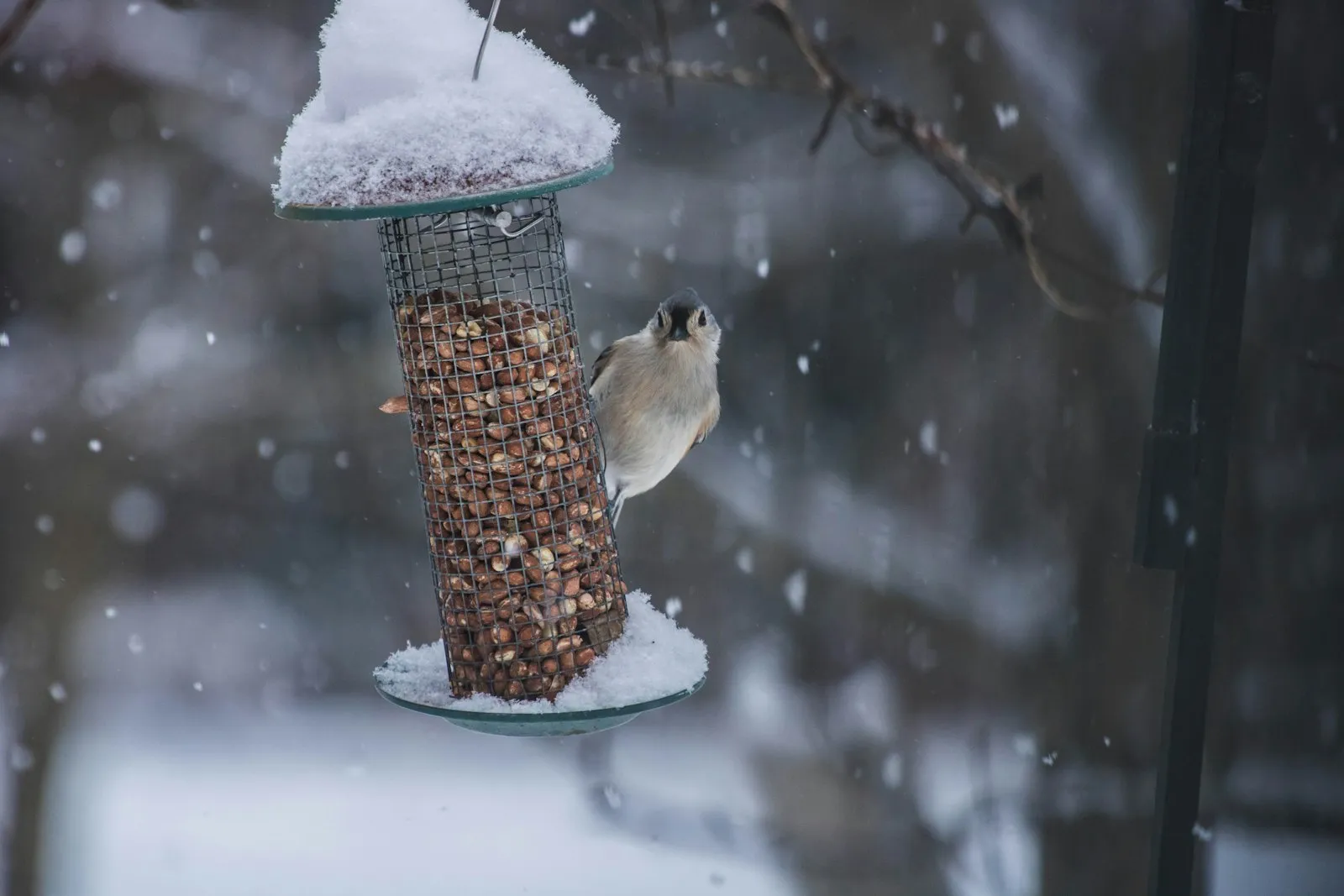
Peanuts are high in fat and protein. FeederWatch says you can offer them shelled or in the shell, raw or roasted, but never salted or coated with flavorings. Jays grab whole peanuts and fly off to hide them; chickadees, nuthatches, and titmice do better with shelled peanuts in a mesh feeder like the one in the photo above.
Cornell adds that grocery-store peanut butter is a good cold-climate food as long as cold weather keeps it firm. Our blue jay diet guide covers the in-shell peanut habit in detail.
Nyjer, millet, and safflower
- Nyjer (thistle): the goldfinch, Pine Siskin, and Common Redpoll seed, per FeederWatch. It needs a feeder with tiny ports or a mesh sock, and it works best on its own rather than in a mix.
- White millet: a handful on the ground keeps juncos and sparrows happy (FeederWatch). This matters in winter because Dark-eyed Juncos, which Cornell Lab calls the “snowbirds” of the middle latitudes, flood most of North America for winter and feed on the ground.
- Safflower: cardinals and other big-billed birds eat it, though FeederWatch notes most birds prefer sunflower. Its real advantage is that squirrels tend to leave it alone, which our squirrel guide covers.
Fruit and mealworms
These reach the birds seed never does. FeederWatch lists mockingbirds, catbirds, bluebirds, robins, and waxwings as fruit eaters, and calls mealworms one of the only foods that reliably attract bluebirds. Chickadees, titmice, wrens, and nuthatches relish mealworms too.
Offer chopped apple, grapes, or raisins softened in warm water (an Audubon tip from its top winter foods list), and throw out anything that molds. Our bluebird diet guide covers the winter shift from insects to fruit.
Winter bird food cheat sheet
| Food | Main winter visitors | Best feeder |
|---|---|---|
| Black-oil sunflower | Cardinals, chickadees, finches, titmice, nuthatches, sparrows | Tube or hopper |
| Hulled sunflower | Same as above, less mess | Tube or covered hopper (keep dry) |
| Suet | Woodpeckers, nuthatches, chickadees, jays | Suet cage or upside-down suet feeder |
| Peanuts (unsalted) | Jays, woodpeckers, chickadees, titmice, nuthatches | Mesh peanut feeder or platform |
| Nyjer | Goldfinches, Pine Siskins, redpolls | Nyjer tube or mesh sock |
| White millet | Juncos, sparrows, doves | Ground or low covered platform |
| Safflower | Cardinals and other big-billed birds | Hopper or tube |
| Fruit, mealworms | Bluebirds, robins, mockingbirds, wrens | Shallow dish or tray |
Which feeders work best in winter
Snow and wet seed are the winter enemies, so favor feeders that keep food dry. Audubon’s winter guide ranks a tube feeder first (“if you hang just one feeder, this should be it”) with metal ports to discourage squirrels, hung at least 5 feet up and either within 3 feet of a window or more than 30 feet away to prevent collisions.
A hopper feeder holds a big supply of seed dry under its roof, which makes it the right choice for cardinals and jays. Add a suet cage, a nyjer feeder if you get finches, and a covered ground or platform feeder at least 10 feet from shrubs (Audubon’s distance) for juncos, sparrows, and doves.
Platform feeders need a dry-seed plan in winter. Wet seed molds, and moldy seed can make birds sick. Use a covered platform with a screen bottom, put out only what birds finish in a day, and scrape off snow and soggy seed before refilling. If squirrels are emptying your winter seed, our best squirrel-proof bird feeders roundup compares the designs that hold up.
Audubon also recommends a simple storm routine: clear snow off the feeder, shake seed feeders before refilling to break up compacted seed, and dump any old leftovers.
Water matters as much as food in winter
In a hard freeze, open water is often harder for birds to find than food. Birds still need to drink, and they still bathe in winter because clean feathers insulate better.
What to do depends on your climate:
- Mild winters (roughly zones 7 to 10): a daily refill with warm water keeps a standard bath usable through most cold snaps.
- Hard winters (roughly zones 3 to 6): a heated bird bath or a clip-on de-icer is the reliable answer.
Our bird bath guide covers wattage, placement, and why glazed ceramic baths crack in freeze zones. Keep cleaning in winter too. Our bird bath cleaning guide explains the routine.
Shelter: give birds somewhere to spend the night
Food gets birds through the day; shelter gets them through the night. Audubon notes that small birds like titmice and juncos seek out the densest trees and shrubs in a wind, and that bluebirds and sparrows huddle together to share heat. Cornell’s account describes chickadees spending the night in tree holes and crevices, and woodpeckers excavating their own winter roost holes, usually in rotting snags.
What that means for your yard:
- Keep or plant dense evergreens (spruce, juniper, eastern red cedar) within a short flight of your feeders.
- Pile brush from fall cleanup near the feeders instead of hauling it away.
- Leave a dead snag standing if it is safely away from your house; it may become a woodpecker’s roost.
- Leave clean nest boxes up. A cleaned-out box offers the same kind of cavity chickadees and other cavity users seek on cold nights.
When to start (and stop) winter bird feeding
Start in fall, before your first hard freeze. October or early November works for most of the US. Birds find a new feeder faster while some natural food is still around, and chickadees, nuthatches, and woodpeckers spend fall shuttling seeds and peanuts to hiding spots, per Audubon, so an early feeder gets built into their routine. Project FeederWatch’s winter count runs November through April, a good guide to the core feeding season.
Keep going into March. By late winter much of the standing seed and fruit has been eaten, so a stocked feeder still matters. In spring, switch your attention to arrivals; our hummingbird feeder timing guide has the dates by state.
Never stop during a cold snap. If you want to quit for the season, do it in a mild spell. If you travel in freezing weather, FeederWatch suggests having someone refill your feeder while you’re away.
Winter feeding by region
Winter feeding is not the same job everywhere.
- Northern US and the snow belt (upper Midwest, New England, northern Plains, mountains): fat and water carry the season. Run suet all winter, keep sunflower topped up, and treat a heated water source as essential. Pine Siskins are irruptive: every few years, Project FeederWatch records a large movement of siskins into the lower 48 states, so keep a nyjer feeder ready.
- Southeast and Gulf Coast: winter is when many of your feeder birds arrive. Cornell Lab says juncos appear over most of the eastern US as winter sets in. Warm afternoons are the problem: raw suet goes rancid above freezing, so use rendered cakes and take suet down in warm spells.
- Pacific Coast: Anna’s Hummingbirds don’t migrate much, and Cornell Lab notes they may visit a feeder all year. On freezing nights, bring the nectar feeder in at dusk and rehang it at first light, or use a heated hummingbird feeder.
- West and Southwest: FeederWatch notes that western birds eat milo (the reddish filler grain in cheap mixes) more readily than eastern birds. In the East, skip mixes heavy in milo.
Keep winter feeders clean (salmonellosis season)
This is the part that keeps feeding from doing harm. Project FeederWatch calls salmonellosis a common cause of death in feeder birds, spread mainly when sick birds’ droppings contaminate food and water. Outbreaks occasionally kill large numbers of Pine Siskins, redpolls, and American Goldfinches, the tight-flocking finches that crowd winter feeders.
How to clean, based on a study FeederWatch summarizes in Preventing disease: What’s the best way to clean your bird feeders?:
- Use bleach. Researchers found that a dilute bleach soak cut Salmonella more than scrubbing with soap and water, and that soap and water alone left enough bacteria on dirty feeders to risk spreading disease.
- Scrub off debris first. Feeders with built-up debris kept more bacteria after cleaning, whatever the method.
- Rinse thoroughly and let the feeder dry before refilling.
- Do it every 2 weeks, and rake up hulls and droppings under the feeder.
If you see a sick bird (fluffed up, lethargic, easy to approach, swollen eyelids), FeederWatch recommends taking down the feeders it uses for a couple of weeks so the flock disperses, and cleaning the feeders and the ground beneath them while they are down. Only licensed rehabilitators can legally treat wild birds, so don’t try to nurse a sick bird yourself.
What not to feed birds in winter
- Bread and kitchen scraps. Filling, low in nutrition, and crowds out the fat birds need. Our can birds eat bread article explains why.
- Bacon drippings and leftovers. Cornell Lab lists both as not recommended. Salted, seasoned, and processed foods don’t belong in a feeder.
- Salted or flavored peanuts. Plain, unsalted only (FeederWatch).
- Cheap mixes full of filler. Audubon’s top-foods list warns against mixes heavy in wheat, red milo, and dyed seed meant for pet birds. Most birds pick out the sunflower and throw the rest on the ground, where it rots.
- Soft suet or oily peanut butter. Cornell warns that soft fat can coat belly feathers. Pull it on any day warm enough to soften it.
- Moldy anything. Moldy seed, fruit, and peanuts can make birds sick. Throw them out.
- Folk hacks. Coffee grounds and a potato in the feeder have no support from Cornell, Audubon, or FeederWatch. Our guide to attracting birds to a feeder covers why.
FAQ
These answers are also marked up as FAQ structured data on the page.
Is it okay to feed wild birds in the winter? Yes. Winter is when feeders help most, and Project FeederWatch says birds don’t become dependent on them. Once you start, keep the feeder stocked through ice and hard cold.
Will birds starve if I stop feeding them in winter? Usually not, because birds forage in many places. The exception is extreme ice, snow, or cold, when a suddenly empty feeder can be a hardship. Stop in a mild spell, and arrange refills if you travel.
What do birds eat in winter? Standing seeds, persistent berries, cached nuts and seeds, and insects hidden in bark. At feeders, offer black-oil sunflower, suet, unsalted peanuts, nyjer, millet, and fruit or mealworms.
When should I start feeding birds for winter? Before your first hard freeze, usually October or early November, so resident birds know your yard before the first snow.
Can you put suet out in winter? Winter is the best time for it. Raw suet turns rancid above freezing, so it is a cold-weather food. Pull any suet that goes soft on a warm day.
Should I feed birds during a snowstorm? Yes. Fill feeders before the storm, brush snow off afterward, shake packed seed loose, and scatter millet on a swept patch of ground for juncos.
What to do this week
Buy a bag of black-oil sunflower seed and a block of suet. Hang a tube or hopper feeder 5 feet up near dense shrubs, and add a suet cage. Decide now how you will keep water open after the first freeze (warm-water refills or a heated bath), and put a reminder on your calendar to clean feeders every 2 weeks. If you enjoy watching what shows up, join Project FeederWatch, whose November-April count turns your feeder into data for Cornell Lab.
Sources
- Cornell Lab of Ornithology, Living Bird: How Do Birds Survive the Winter? (body temperature, overnight shivering and fat use, roost cavities)
- Cornell Lab of Ornithology, All About Birds: About Suet, Mealworms, and Other Bird Foods (suet in cold weather, rancidity, peanut butter, foods to avoid)
- Cornell Lab of Ornithology, All About Birds: Dark-eyed Junco and Anna’s Hummingbird (winter range)
- Project FeederWatch: Can birds become dependent on bird feeders?, Food Types, Sick Birds and Bird Diseases, Preventing disease: What’s the best way to clean your bird feeders?
- Audubon: The Audubon Guide to Winter Bird Feeding, Top 10 Foods for Winter Bird Feeding, How Do Birds Cope With Cold Winter Weather?