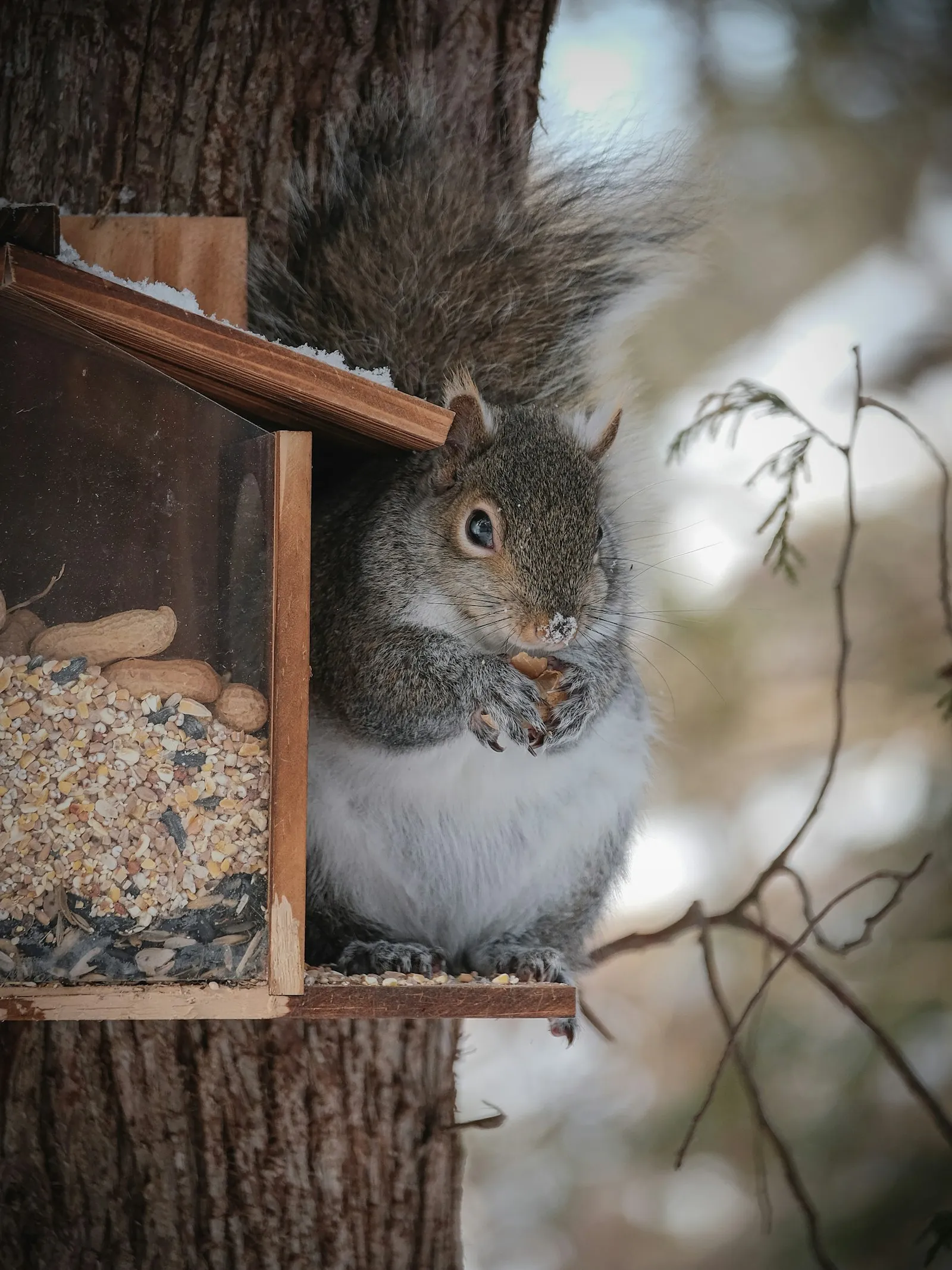
Squirrels can empty a bird feeder in an afternoon, chew it to pieces, and scare off the birds you actually wanted. The good news: the best squirrel-proof bird feeders genuinely work, and they stop squirrels without hurting them. The honest news, which most roundups skip: the feeder is only half the fix. Where you put it matters just as much. This guide compares the real mechanisms that stop squirrels, names specific feeders we verified against the manufacturers, and tells you when a $15 baffle beats a $130 feeder.
Quick picks
- Best overall: Brome Squirrel Buster Plus (weight-activated, weight-adjustable, large capacity)
- Best budget: Brome Squirrel Buster Standard (same mechanism, smaller and cheaper)
- Best for cardinals: Brome Squirrel Buster Plus, set to admit heavier songbirds
- Best for keeping out big birds too: Perky-Pet Squirrel-Be-Gone Max
- Best spinning feeder: Droll Yankees Yankee Flipper (motorized, premium)
- Best value: a plain feeder on a baffled pole (see how to keep squirrels out of bird feeders)
How squirrel-proof bird feeders work (the 4 mechanisms)
Before you buy, understand how a feeder actually stops a squirrel. There are four approaches, and the right one depends on which birds you want to feed and where you can hang it.
Weight-activated (the most reliable)
A weight-activated feeder has a spring-loaded outer shroud or perch ring. Light birds don’t trip it, but when a heavier squirrel climbs on, its weight pulls the shroud down and closes the seed ports. Brome describes its Squirrel Buster this way: “When a squirrel climbs onto the feeder, its weight automatically forces the shroud down, closing access to the ports.” The squirrel gives up and leaves unharmed. The best models let you adjust the weight threshold, so you can fine-tune which birds get in. This is the most reliable mechanism for the widest range of yards.
Caged
A caged feeder surrounds the seed with a wire cage sized so small songbirds (chickadees, finches, titmice, nuthatches) slip through while squirrels and larger birds cannot. It is the most physically foolproof design, but it also excludes bigger birds you might want, like cardinals and jays. Choose a cage only if your goal is specifically to feed small birds and nothing else.
Spinning / motorized
A motorized feeder has a battery-powered perch ring that stays still for birds but spins when a squirrel’s heavier weight lands on it, gently tossing the squirrel off. Droll Yankees says the Yankee Flipper’s “spinning action then gently tosses the squirrel off before it can devour your seed supply.” These work and are genuinely fun to watch, but they cost more and depend on a rechargeable battery.
Pole-mounted + baffle (best value)
The oldest trick is also the cheapest and, done right, the most effective: mount any feeder on a smooth metal pole and add a baffle (a dome or cylinder the squirrel cannot climb past). This uses placement, not a special feeder, so it works with feeders you already own. The full method, including the 5-7-9 placement rule, is in our guide on how to keep squirrels out of bird feeders.
The best squirrel-proof bird feeders
Best overall: Brome Squirrel Buster Plus
The Brome Squirrel Buster Plus is the feeder we point most people to first, and it is the one our squirrel guide already recommends. It holds a large 5.1 pounds of seed, stands about 28 inches tall, and uses the weight-activated shroud described above. Two things make it the standout: the weight setting is adjustable, so you can tune exactly which birds trip it, and the parts squirrels can reach are chew-proof. Brome’s own summary is blunt: squirrels “are foiled but not harmed in any way.” It is premium-priced (roughly $100 to $130), but it is a buy-it-once feeder.
Best budget: Brome Squirrel Buster Standard
If the Plus is more feeder than you need, the Brome Squirrel Buster Standard uses the same weight-activated mechanism in a smaller, lower-cost body. You give up some capacity, but you keep the core design that makes the line work. It is a good pick for a smaller yard or a second feeder.
Best for keeping out large birds too: Perky-Pet Squirrel-Be-Gone Max
Some yards have a grackle or starling problem on top of squirrels. The Perky-Pet Squirrel-Be-Gone Max uses a weight-activated “Seed Shield” that, in Perky-Pet’s words, is “calibrated to support the weight of birds but not squirrels,” closing the ports under a squirrel’s weight. Its metal construction resists chewing and a Sure-Lock cap stops squirrels from lifting the lid. Because it is tuned to shut out heavier animals, it also discourages large nuisance birds, which is the tradeoff: it is less suited to feeding cardinals than an adjustable feeder.
Best spinning feeder: Droll Yankees Yankee Flipper
The Droll Yankees Yankee Flipper is the motorized option, and it earned a #1 squirrel-proof feeder nod from Birds & Blooms. A squirrel’s weight starts the motor, and the perch spins the squirrel gently off. It holds about 5 pounds, uses a rechargeable battery, and has UV-resistant, powder-coated metal parts. It is the most expensive approach and the battery is one more thing to maintain, but nothing else is quite as entertaining, and it works.
Best value: a plain feeder + a pole baffle
If you want the lowest cost per squirrel foiled, skip the specialty feeder. A basic tube or hopper feeder on a smooth steel pole with a wraparound baffle, positioned correctly, is the setup our squirrel guide considers the single most reliable fix. A baffle costs a fraction of a premium feeder and works with gear you already own. The catch is placement, which the next section and our squirrel guide cover in detail.
Comparison table
| Feeder | Mechanism | Capacity | Best for | Price tier |
|---|---|---|---|---|
| Brome Squirrel Buster Plus | Weight-activated (adjustable) | 5.1 lb | Most yards; cardinals | Premium |
| Brome Squirrel Buster Standard | Weight-activated | Smaller | Budget; small yards | Mid |
| Perky-Pet Squirrel-Be-Gone Max | Weight-activated (Seed Shield) | 4 lb | Also excluding big birds | Mid |
| Droll Yankees Yankee Flipper | Motorized spinning perch | ~5 lb | Wow factor; problem squirrels | Premium |
| Plain feeder + pole baffle | Placement (baffle) | Varies | Best value; any feeder | Low |
How to choose
- You want cardinals and jays too: pick a weight-adjustable feeder (Brome Squirrel Buster Plus) and set the threshold to admit heavier songbirds while excluding squirrels.
- You only want small birds: a caged feeder or a tightly-set weight-activated feeder keeps everything bigger out.
- You also fight grackles or starlings: a weight-tuned feeder like the Perky-Pet Squirrel-Be-Gone Max shuts out heavier nuisance birds along with squirrels.
- You’re on a budget: buy a baffle, not a feeder, and place it by the 5-7-9 rule.
- You want a show: the Droll Yankees Yankee Flipper.
For what to actually fill any of these with, see our guide on how to attract birds to a bird feeder, and for the seed cardinals prefer, what cardinals eat.
The honest truth: placement beats the feeder
Here is the part the product roundups leave out. A squirrel can jump roughly 5 feet straight up and 7 feet sideways, and run down anything above a feeder. So a $130 squirrel-proof feeder hung from a low branch, or on a pole next to a fence, still gets raided, because the squirrel never has to defeat the mechanism. It just reaches the feeder directly.
Get the placement right and even a basic feeder becomes hard to beat: at least 5 feet off the ground, 7 feet from the nearest launch point (tree, fence, deck rail), and 9 feet below any overhanging branch. Add a pole baffle and you have covered the climb-up route too. Our full walkthrough is in how to keep squirrels out of bird feeders. Buy the feeder for convenience and capacity; win the war with placement.
What to skip
- Greased poles and petroleum jelly. They wear off in hours and, worse, jelly coats bird feathers and can be fatal. Never use it.
- Slinky-on-a-pole hacks. Entertaining, briefly effective, and quickly defeated. A real baffle costs little more and lasts.
- Cheap “squirrel-proof” feeders with flimsy plastic parts. Squirrels chew through them. If a feeder relies on a mechanism, it needs metal where the squirrel bites.
- Hot-pepper seed as your only defense. Capsaicin does deter squirrels, but it is a supplement to a good feeder and placement, not a standalone fix. It washes off and blows away.
FAQ
These answers are also marked up as FAQ structured data on the page.
Do squirrel-proof bird feeders really work? Yes, the weight-activated and motorized ones do, and they foil squirrels without harming them. But placement matters just as much: any feeder within a squirrel’s jump still gets raided.
What is the best type of squirrel-proof bird feeder? Weight-activated feeders are the most reliable for most yards. Caged feeders suit small-bird-only setups, spinning feeders work but cost more, and a plain feeder on a baffled pole is the best value.
What is the best squirrel-proof feeder for cardinals? A weight-adjustable feeder like the Brome Squirrel Buster Plus, tuned to admit heavier cardinals while still excluding squirrels.
Do weight-activated squirrel-proof feeders hurt squirrels? No. They just close the ports under the squirrel’s weight; the squirrel leaves unharmed. Avoid injurious DIY tricks like greased poles.
What is the cheapest way to squirrel-proof a bird feeder? A smooth metal pole plus a baffle, placed by the 5-7-9 rule. It costs far less than a premium feeder and works as well or better.
Sources
- Brome Bird Care: Squirrel Buster Plus (weight-activated shroud mechanism, adjustable weight, chew-proof)
- Perky-Pet: Squirrel-Be-Gone Max (weight-activated Seed Shield, Sure-Lock cap)
- Perky-Pet / Droll Yankees: Yankee Flipper (motorized spinning perch)
- Perch & Feed: How to Keep Squirrels Out of Bird Feeders (the baffle method and 5-7-9 placement rule)