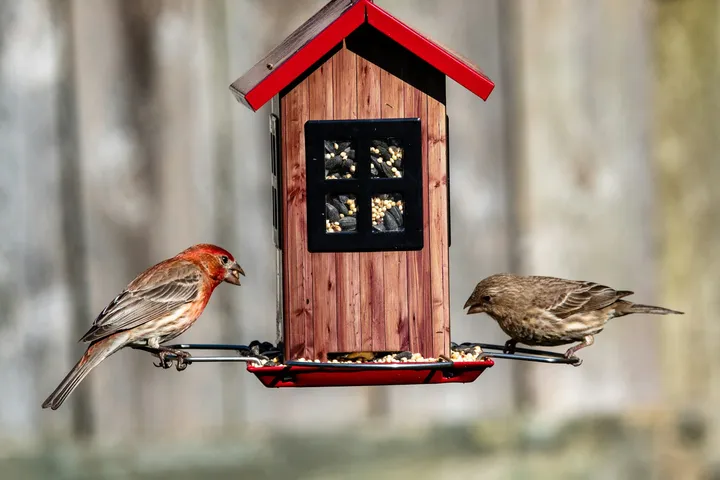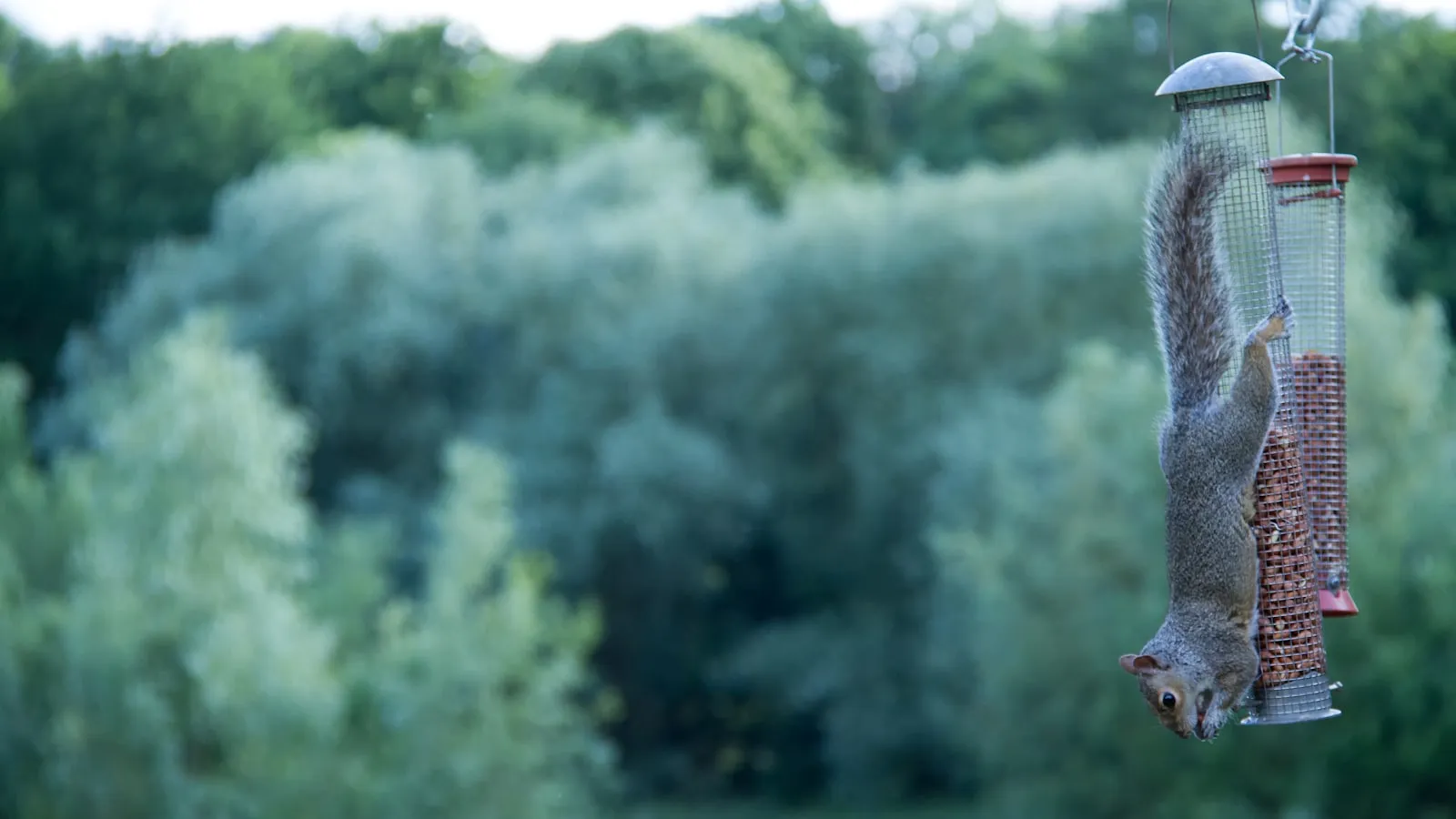
If a squirrel is on your bird feeder right now, the question is not whether you can stop them. You can. The question is which method makes sense for your specific yard. Tree-hung feeder vs. pole-mounted feeder is a different problem; squirrels plus raccoons is a different problem; light red squirrels vs. heavy grays is a different problem. This is how to keep squirrels out of bird feeders by setup type, with the 5-7-9 placement rule explained properly, an honest verdict on what actually works, and the deterrent methods you should skip.
Quick answer
The single most reliable setup is a pole-mounted feeder with a squirrel baffle, positioned by the 5-7-9 rule: 5 feet off the ground, 7 feet horizontal from any jumping surface (tree, fence, deck rail), and 9 feet below any drop point above the feeder (branch, eave). Add safflower seed to make the feeder less rewarding if a squirrel does get there. Skip greased poles, slinkys, coffee grounds, and hot pepper dust; none works long-term.
Why squirrels are so hard to keep out (the biology)
Every defense in this article exists because gray squirrels are physically remarkable. Knowing what they can do tells you why each method works.
A typical eastern gray squirrel:
- Vertical-jumps about 4 feet from a standstill. They can launch from ground level onto a feeder at 4 feet, which is why the placement rule starts at 5 feet.
- Horizontal-jumps 9 to 10 feet from a tree branch or rooftop. A feeder hanging 6 feet from the nearest branch is in range.
- Runs upside-down on a wire. A feeder hanging from a horizontal wire stretched between two posts is not a defense; squirrels run along the bottom of the wire to reach it.
- Climbs almost any rough surface, including wood posts, plastic poles, and the bark of trees obviously. Smooth metal at vertical angle is the exception: squirrels cannot grip slick steel well, which is why pole baffles work.
- Chews through wood, soft plastic, and thin aluminum if motivated. They will not chew through stainless steel or hardened plastic with reinforced ports, but they will systematically destroy a flimsy plastic feeder over weeks.
- Learns and remembers. A squirrel that gets to the feeder once will try the same approach the next 200 times. Squirrels that have failed at a setup for two weeks usually move on, but the trial-and-error phase is real.
Take their climbing and jumping away from them and you’ve taken away most of what they can do. That’s what the rest of this article is about.
The 5-7-9 rule for feeder placement
The 5-7-9 rule is the single most overlooked piece of advice in squirrel-proofing. Every other method (baffle, weight-sensitive feeder, safflower) is less effective if the placement is wrong, and dramatically more effective if the placement is right. The rule:
- 5 feet off the ground. Above the squirrel’s vertical-jump-from-standstill range.
- 7 feet horizontal distance from any surface a squirrel could jump from. That includes tree trunks, fence rails, deck rails, woodpiles, parked cars, and the side of the house. 7 feet puts the feeder just outside their normal horizontal-jump arc.
- 9 feet below any drop point above the feeder. Branches, eaves, gutters, roof lines. Squirrels will jump down 9 feet onto a feeder readily; 10 feet is the typical upper limit.
All three numbers have to be true at the same time. A feeder 5 feet off the ground but 4 feet from a tree trunk is a squirrel buffet. So is a feeder 7 feet from the tree but with a branch 6 feet directly above it. Walk around your feeder. Identify every surface a squirrel could launch from. If anything is within 7 feet horizontally or 9 feet vertically, you have a problem.
In small yards where 7 feet of horizontal clearance is impossible, you have two real options: switch to a weight-sensitive feeder, or accept the squirrels and feed them at a decoy station. Cheating the 5-7-9 numbers does not work reliably.
Duncraft’s bird-feeder placement guide is one of the cleaner write-ups of the rule with diagrams.
Method 1: Pole-mounted feeder + squirrel baffle (the best fix)
This is the single most-effective setup. A 5-foot smooth steel pole driven into the ground, with a baffle mounted at about 3 to 4 feet (just below where the squirrel’s vertical jump tops out, so they hit the baffle before they reach the feeder). The squirrel climbs the pole, encounters the smooth flared dome of the baffle, cannot reach around it or over it, and gives up.
Two baffle types that work
- Wraparound (torpedo) baffle. A 17- to 18-inch metal cylinder or dome that clamps around the pole. Open at the bottom, closed or domed at the top. The squirrel climbs into the open bottom and is stuck on the inside; eventually they back out. This is the more reliable style. The Erva Tool 17-inch wraparound baffle and the Audubon-branded 18-inch torpedo baffle are two standards.
- Dome (disc) baffle. A flared dome that mounts above the feeder rather than below. Better for tree-hung feeders than pole-mounted ones (see Method 6 below). Less effective against squirrels jumping up the pole, since they can sometimes grip below the dome.
For pole setups, go with the wraparound. For hanging setups, the dome.
What does NOT work for pole setups
Greased poles work for a few hours until the grease wears off or dust accumulates. Petroleum jelly (Vaseline) sticks to bird feathers and is dangerous. Slinkys are entertaining but not durable defenses. Hot-pepper sprays on the pole wash off in the first rain. Use a smooth steel pole and a proper baffle.
Method 2: Weight-sensitive squirrel-proof feeders
If you can’t run a pole (apartment balcony, no soil to drive a pole into, HOA restrictions on yard hardware), the second-best option is a weight-sensitive feeder. The mechanism: the perch ring is spring-loaded. A light bird (chickadee at 0.4 oz, finch at 0.5 oz, cardinal at 1.5 oz) doesn’t depress the ring enough to close anything. A heavy squirrel (eastern gray at 14 to 21 oz, red squirrel at 5 to 9 oz) lands on the ring, depresses it, and physically blocks the feeding ports. For a full comparison of the models worth buying, see our roundup of the best squirrel-proof bird feeders.
Two models that actually deliver
- Brome Squirrel Buster Plus. The reference model. ~$80. Adjustable weight calibration on the bottom dial (you can set it so even a 6-oz red squirrel triggers the mechanism, or so only gray-squirrel-size weights trip it). Lifetime warranty against squirrel damage. The closest thing to a guaranteed solution.
- Roamwild PestOff. ~$55. Similar mechanism, more weather-sealed (good for rainy climates), slightly smaller capacity. Marginally less reliable than the Brome but a strong budget option.
When weight-sensitive feeders fail
Two specific cases:
- Very light squirrels. A young red squirrel under 5 oz may not trigger the mechanism on a feeder calibrated for grays. Adjust the calibration dial (Brome) or accept that the feeder won’t stop the smallest red squirrels.
- Lean-in perches. If you’ve mounted the feeder near a railing or trellis where a squirrel can hold the rail with their feet and lean into the feeder ports without putting full weight on the perch, the mechanism doesn’t trigger. Same 5-7-9 placement rules apply: keep the feeder physically isolated from any leaning surface.
Method 3: Safflower seed (the seed switch)
This one is undersold. Safflower seed has a bitter outer shell that most squirrels reject. Cardinals, chickadees, titmice, house finches, and downy woodpeckers all eat safflower readily. Blue jays, grackles, and starlings do not (which is a feature if those species are crowding your feeder). Project FeederWatch’s citizen-science data on backyard feeder visitation backs this up across most of the eastern U.S. and Canada.
How to switch
Replace one feeder’s contents with 100 percent safflower seed for two weeks. Watch what happens. Most yards see squirrel visits drop sharply within a week (the squirrels taste the safflower, reject it, and stop visiting). The birds that eat safflower will keep visiting; the birds that don’t will move to your other feeders if you have them.
If you only have one feeder and don’t want to lose blue jays and grackles, mix 50/50 safflower and black-oil sunflower. The squirrels still pick out the sunflower seeds, but at half the rate, and the other species adjust.
What it does not work for
Black-bear regions. A bear will not be deterred by safflower. If you have bear activity, take feeders down at night.
Method 4: Hot pepper (capsaicin), with the honest caveats
The conventional folk wisdom: birds cannot taste capsaicin (the active compound in chili peppers) because their TRPV1 receptors don’t respond to it, while mammals (including squirrels) get the full burning sensation. Mix cayenne pepper into your seed and you have a squirrel deterrent that doesn’t affect the birds.
The 2025 research nuance: new work from Maryville University, reported by Audubon magazine, found that at extremely high Scoville levels (around 500,000 SHU and above), birds do start avoiding feeders, with Northern Cardinals showing the steepest drop. The earlier “birds can’t taste capsaicin at all” view is incomplete. Their TRPV1 receptors are less sensitive than mammalian ones, but they’re not zero.
Practical implication: commercial squirrel-deterrent capsaicin seed coatings (typical strength roughly 40,000 to 100,000 SHU equivalent) are well below the threshold where birds show aversion. They likely still work as designed, but the safer practice is:
- Use commercial pre-treated seed rather than dusting raw cayenne on your existing seed (better dose control, less variability).
- Never use hot pepper as a powder on the outside of the feeder. Wind can blow it into bird eyes, and you will get it in your eyes when you refill.
- Wear gloves and avoid touching your face when handling any capsaicin-treated seed.
Audubon’s primary squirrel-feeding article treats capsaicin as a valid but secondary tool; we agree. Use it after the baffle and placement basics are right, not before.
Method 5: Decoy squirrel feeding station
The counterintuitive method. Give the squirrels their own food source 15 to 25 feet from the bird feeder. A simple corn-on-the-cob holder, a peanut feeder, or even an open dish of cracked corn works. A well-fed squirrel works less hard at the bird feeder, and the decoy station gives them a path of least resistance.
This works best paired with safflower in the bird feeder, so the squirrel’s incentive to come back is genuinely low (boring food at the bird feeder, good food at the squirrel feeder).
It does not work in yards with very high squirrel density, where you’re feeding 6 squirrels and they bring 6 more. In that case the decoy station becomes a squirrel attractant for the neighborhood and you may end up with worse pressure on the bird feeder, not less.
Method 6: Tree-hung feeders (the harder problem)
Tree-hung feeders are the hardest squirrel problem. You can’t pole-baffle a feeder that hangs from a branch. The squirrels run down the branch, down the wire, onto the feeder. Three things help:
- Long drop wire. Hang the feeder at least 4 feet below the branch on a wire too thin for the squirrel to grip well. A 16- to 18-inch length isn’t enough; you need 48-plus inches.
- Dome baffle above the feeder. Mounts on the wire 6 to 8 inches above the feeder. Squirrel slides down the wire, hits the dome, slides off.
- Combine with a weight-sensitive feeder. Even with the dome above, an athletic squirrel will sometimes drop directly onto the feeder. Brome Squirrel Buster Plus on a tree-hung setup is the most reliable combo.
Honest verdict: tree-hung feeders are easier to defeat than pole-mounted ones, and you may need to accept some squirrel visits even with the dome + weight-sensitive feeder combo. Where possible, move to a pole.
Method 7: Caged feeders (the small-bird-only solution)
A caged feeder is a wire cage around a tube or hopper feeder. The mesh is sized so small birds (chickadees, titmice, finches, sparrows) can pass through but squirrels (and larger birds like blue jays, grackles, starlings) cannot. This is a structural solution rather than a deterrent.
Trade-off: you also exclude the larger songbirds many yards want at the feeder. If you specifically want chickadees and finches and don’t care about cardinals, jays, or woodpeckers, a caged feeder is the easiest solution. Otherwise it’s overkill.
What about raccoons, chipmunks, and other yard mammals?
The squirrel methods above do NOT all work for other mammals:
- Raccoons. Heavier (10 to 30 lb), more intelligent, mostly nocturnal. They defeat most squirrel baffles by pulling the feeder down or by bracing on the pole and reaching around. The defense is a larger cone-style raccoon baffle, plus bringing feeders in at night. Weight-sensitive feeders generally fail against raccoons (too heavy to ignore the spring, but the raccoon can sit on the ground and pull the feeder down).
- Chipmunks. Tiny (2 to 5 oz). They slip under weight-sensitive feeder perches without triggering anything. They also climb wherever they want. The fix is a caged feeder with mesh sized smaller than 1.5 inches, or a feeder mounted in a way chipmunks cannot reach (rare; they’re excellent climbers).
- Red squirrels. Smaller and lighter than grays (5 to 9 oz). May not trigger weight-sensitive feeders calibrated for grays. Use the Brome calibration dial or a different feeder.
- Bears. Take feeders in at night during bear season. No feeder design stops a bear; only removing the food source does.
Project FeederWatch’s article on squirrels at feeders covers the multi-mammal version of this problem with their citizen-science observations on which combinations of methods work.
What to skip
Common advice that doesn’t work, or actively makes things worse:
- Greased poles. Works for a few hours, fails after rain or dust accumulates. Squirrels also lick the grease off, which is a separate problem.
- Petroleum jelly (Vaseline) on the pole. Same problem as grease, plus the welfare issue: if a bird lands on a greased pole, the jelly sticks to feathers and damages waterproofing. Same warning we made in our hummingbird ants and bees article about Vaseline on hummingbird feeder hangers. Don’t use it.
- Slinkys on the pole. Works briefly. Squirrels learn around them within days, pull them down, or jump over them. A real baffle costs only a few dollars more and lasts years.
- Aluminum foil wrapping. Folk remedy with no consistent evidence behind it.
- Coffee grounds at the base of the pole. Same. The “squirrels hate the smell” claim doesn’t hold up; urban squirrels live in coffee-grounds environments and ignore them.
- Hot pepper dust on the feeder body. Eye and respiratory irritant for birds, for you when refilling, and for non-target wildlife. If you use capsaicin, use commercial pre-treated seed, not loose dust.
- “Squirrel repellent” spray products. Most are unproven. The few that work (capsaicin-based) work for a few days until they wash off.
- Letting the dog out every time you see a squirrel. You’re not there at 6am when the squirrels do most of their feeding. A pole-mounted baffle is.
- Hoping they’ll get bored. They won’t.
FAQ
What will keep squirrels off bird feeders?
The single most reliable setup is a pole-mounted feeder with a squirrel baffle, positioned by the 5-7-9 rule (at least 5 feet off the ground, 7 feet from any jumping surface, 9 feet below any overhead drop point). Add safflower seed to make the feeder less rewarding even on the rare occasion a squirrel gets there. Weight-sensitive feeders like the Brome Squirrel Buster Plus also work, particularly when a pole setup isn’t possible. Skip greased poles, slinkys, and coffee grounds; none are reliable long-term.
What is the 5-7-9 rule for squirrels?
The 5-7-9 rule is a bird-feeder placement guideline: 5 feet off the ground, 7 feet of horizontal distance from any surface a squirrel could jump from (tree trunk, fence, deck rail, woodpile, parked car), and 9 feet below any overhead drop point (branch, eave, gutter, roof line). Gray squirrels can vertical-jump about 4 feet from a standstill and horizontal-jump about 9 to 10 feet from a branch, so the 5-7-9 numbers put the feeder just outside their normal envelope. All three numbers have to be true at once.
Why should I sprinkle coffee grounds around my bird feeder?
You shouldn’t, at least not as a squirrel deterrent. The claim is that the smell deters squirrels, but there’s no good evidence for it. Squirrels in coffee-shop neighborhoods raid trash cans full of coffee grounds without hesitation. The grounds can also lower the pH of the soil under the feeder over time, which affects what grows there. An ant moat for hummingbird feeders works for ants but coffee grounds do not work for squirrels.
What smell do squirrels hate the most?
There’s no consistent evidence that squirrels strongly avoid any specific smell to the point where it functions as a reliable deterrent. Cayenne, mint, white vinegar, predator urine, and garlic all get cited in folk advice; none of them holds up well under repeated use. The capsaicin in cayenne does deter squirrels at high enough concentrations, but it works as a taste deterrent (and contact irritant), not a smell. Mechanical defenses (baffles, weight-sensitive feeders, the 5-7-9 rule) work much better than scent-based ones.
Do squirrels really avoid safflower seed?
Yes, most of the time. Safflower has a bitter outer shell that most gray and red squirrels reject. The exception: a hungry squirrel with no alternatives will eat safflower (no deterrent is absolute). Cardinals, chickadees, titmice, house finches, and downy woodpeckers all eat safflower readily, so swapping a feeder from black-oil sunflower to 100 percent safflower usually results in fewer squirrel visits and a similar bird visit count. Try one feeder first; if your local squirrels are determined enough to eat through it, you’ll know.
Will a slinky on the pole keep squirrels off the feeder?
Short-term and unreliably. The slinky-as-baffle method works for some yards for a few days, but squirrels learn the slinky’s behavior quickly: they climb above the spring, jump through the coils, or simply pull the slinky down. A real pole baffle (a smooth dome or cylinder fixed in place) works much more reliably and costs only marginally more. Skip the slinky.
What you can do this weekend
If you have one weekend and roughly $50: buy a pole-mounted wraparound baffle, set it on a smooth steel pole at 3 to 4 feet, walk your yard with a tape measure and confirm the 5-7-9 numbers, and switch one feeder’s seed to safflower. That’s the 80 percent solution for almost every backyard. If your yard can’t accommodate the placement rule (too small, too many surfaces within 7 feet), order a Brome Squirrel Buster Plus and skip the pole.
The safflower switch has a bonus: it is the seed cardinals love and squirrels reject, so our how to attract cardinals guide doubles as a squirrel-reduction tactic. For the broader logic of matching feeder, seed, and placement to the birds you want, see our how to attract birds to a bird feeder pillar.
If you also have a hummingbird feeder, squirrels are rarely the problem there (nectar isn’t appealing to them), but ants and bees are. The best hummingbird feeder guide covers picks by use case, and the 4:1 nectar recipe takes two minutes. For the harder backyard mammal problems (raccoons, tree-only feeders, bear country), our other articles on these specific cases will cover the full setup.
Sources
- Project FeederWatch (Cornell Lab): How do I keep squirrels off my feeders? (citizen-science observations on which methods work in backyards across North America)
- Audubon: How to Stop Squirrels From Raiding Your Bird Feeders (expert interview, tiered method ranking)
- Audubon: Hot Take Seems Like Birds Can Taste Spice After All (Maryville University research on bird capsaicin response at high Scoville levels, December 2025)
- Duncraft: Bird Feeder Placement Guide (5-7-9 rule with diagrams)