What do wrens eat? Mostly insects and spiders, not birdseed. Wrens are insectivores, so the honest answer to feeding them has little to do with a seed feeder and everything to do with bugs, brush, and (for one species) a suet cake in winter. This guide covers the real wren diet, why only the Carolina Wren reliably visits feeders, what to put out, and how to attract them, all grounded in Cornell Lab of Ornithology research.
TL;DR
- Wrens are insectivores: insects and spiders make up the bulk of the diet (Cornell Lab), with only a small amount of plant matter.
- They rarely eat birdseed. A standard seed feeder will not reliably draw a wren.
- The Carolina Wren is the one species that visits feeders, mostly for suet and mealworms, especially in winter.
- The House Wren essentially never visits feeders, but it will nest in your yard and eat insects all season.
- The best way to attract wrens is habitat: brush piles, native plants, leaf litter, no pesticides, and a well-placed nest box.
- Baby wrens eat insects, soft-bodied invertebrates the parents catch nearby.
What do wrens eat in the wild (mostly insects and spiders)
Wrens are built for hunting invertebrates. They forage low and close to cover, poking their slightly curved bills into leaf litter, bark crevices, brush piles, and tangles to flush out insects and spiders. Seed is a footnote in their diet, which is the single most important thing to understand about feeding them.
The Carolina Wren diet
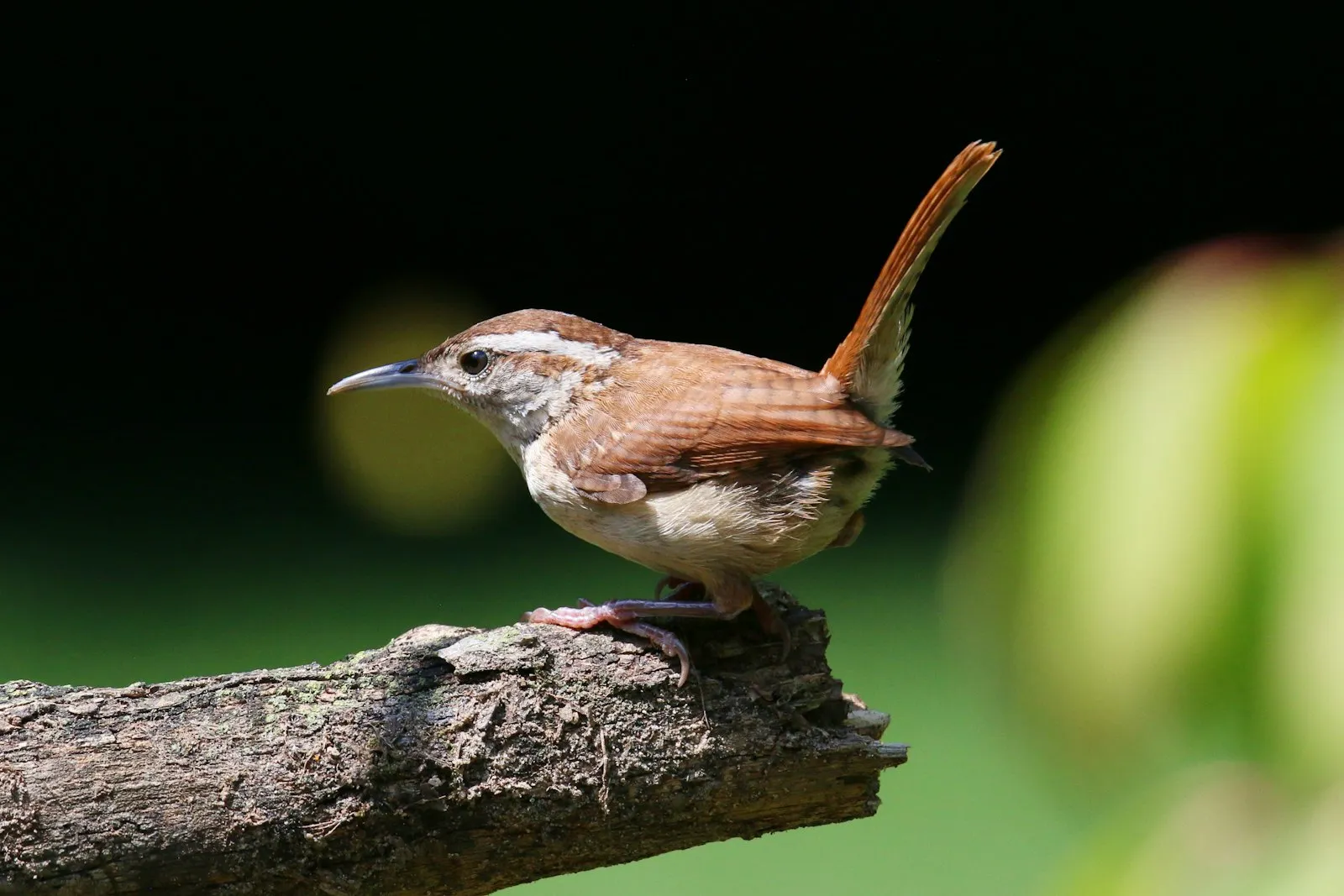
The Carolina Wren is the bold, rusty-brown wren with a white eyebrow stripe and a tail it cocks straight up. Per Cornell Lab’s All About Birds, “insects and spiders make up the bulk of this wren’s diet.” Common foods include caterpillars, moths, stick bugs, leafhoppers, beetles, grasshoppers, crickets, and cockroaches. Carolina Wrens occasionally eat lizards, frogs, or snakes, and they take a small amount of plant matter such as fruit pulp and the seeds of bayberry, sweetgum, or poison ivy.
That last detail matters: even the plant part of the diet is wild fruit and native seeds, not the sunflower and millet in a feeder mix.
The House Wren diet
The House Wren (Cornell now lists it as the Northern House Wren after a 2024 split, but most people still call it the House Wren) is smaller, plainer, and even more insect-focused. Cornell Lab reports it eats “a wide variety of insects and spiders, including beetles, caterpillars, earwigs, and daddy longlegs,” plus more mobile prey like flies, leafhoppers, and springtails. House Wrens also eat snail shells, probably for the calcium and as grit to help digestion.
There is no seed in that list, which is why a House Wren will nest in your yard but ignore your feeders entirely.
Do wrens eat birdseed?
Mostly no. This is the question the rest of the internet answers poorly, and the accurate answer is the one that helps you. Wrens are insectivores. Cornell lists no seed in the House Wren’s diet, so it effectively ignores seed feeders. The Carolina Wren will occasionally take sunflower chips (the de-shelled hearts) or a peanut bit at a feeder, but seed is a minor part of the diet, not what pulls a wren in. If your goal is wrens, a tube feeder full of mixed seed is the wrong tool. Compare that with a seed-forward eater like the cardinal, whose diet centers on cracking seeds, or the blue jay, which runs mostly on nuts and acorns. Wrens sit at the opposite end of the diet spectrum.
Carolina Wren vs House Wren: which one visits feeders
This is the practical fork. If you want to “feed wrens,” the species you can realistically attract to food is the Carolina Wren.
- Carolina Wren: A year-round resident across the eastern and southeastern United States. These wrens do not migrate and hold their territory through the seasons, so the bird in your yard in July is likely the same one in January. Cornell Lab states plainly that “Carolina Wrens often come to backyards if food is available and will visit your suet-filled feeders in winter.” This is your feeder wren.
- House Wren: A summer breeder across most of the continent that migrates south for winter. It hunts insects in shrubs and brush and will readily use a nest box, but it does not visit feeders for food. You attract House Wrens with habitat and nest sites, not with a feeder.
The robin makes a useful comparison here: like wrens, robins are insect-and-fruit eaters that largely ignore seed feeders, which is why you attract both with habitat and water rather than a seed mix.
The best foods to feed wrens at a feeder
If you have Carolina Wrens, lead with insect-based foods. These match what the bird actually eats and are far more effective than seed.
- Suet is the single most reliable wren food, and the one Cornell Lab specifically connects to Carolina Wrens at winter feeders. A suet cake in a cage feeder, placed near cover, is your best bet.
- Mealworms, live or dried, work because they are quite literally insects. Offer them in a shallow tray near brush rather than out in the open. (Mealworms are also the food that draws bluebirds, so a mealworm-friendly feeder setup does double duty.)
- Peanut pieces and sunflower chips sometimes work for Carolina Wrens, since the de-shelled hearts are soft and easy to handle. Treat these as bonus, not the main draw.
Placement matters as much as the food. Wrens forage close to cover, so a feeder near a brush pile, hedge, or shrubby corner will outperform one in the open middle of a lawn. For the general principles, see our guide to attracting birds to a feeder.
Wren feeder-food cheat sheet
| Food | Will wrens eat it? | Notes |
|---|---|---|
| Suet | Yes (Carolina Wren) | Best feeder food; Cornell ties it to winter Carolina Wrens |
| Mealworms (live or dried) | Yes | Insect-based; offer in a tray near cover |
| Peanut pieces | Sometimes | Carolina Wren may take small soft bits |
| Sunflower chips (hearts) | Sometimes | De-shelled only; minor part of diet |
| Mixed birdseed / millet | Rarely | Wrong food; wrens are not seed eaters |
| Whole sunflower in shell | No | Wrens do not crack hard seed shells |
| Nectar | No | Wrens are not nectar feeders |
What do wrens eat in winter?
In winter the diet stays insect-based, but the strategy shifts. Carolina Wrens do not migrate, so they spend the cold months foraging through leaf litter, under bark, and in brush for dormant insects, spiders, and egg cases. This is exactly when a suet feeder earns its place, and when supplemental mealworms help most, because natural insects are hardest to find.
Winter is also the hardest season for this species. Cornell Lab notes that the Carolina Wren “is sensitive to cold weather, with the northern populations decreasing markedly after severe winters.” A reliable suet cake and a sheltered roosting spot can genuinely help local wrens survive a hard freeze. House Wrens skip the problem entirely by migrating south.
What do baby wrens eat?
Insects, almost exclusively. Like nearly all songbirds, wrens feed their nestlings a high-protein diet of soft-bodied invertebrates (caterpillars, spiders, and small insects) that the parents catch nearby. Growing chicks need protein that seeds cannot supply, which is the same reason an insect-rich yard matters more than a feeder for nesting birds of many species. For the broader picture of what young birds eat as they grow, see our guide on what fledgling birds eat.
This is also why pesticides are so counterproductive if you want wrens: spraying the caterpillars and beetles is removing the exact food a wren family depends on.
How to attract wrens (food, habitat, nest boxes)
Food is the smallest lever. For wrens, habitat and nest sites do the heavy lifting.
- Leave some mess. A brush pile, a leaf-littered border, and dense shrubs give wrens the bug-rich, low cover they hunt in. Tidy lawns hold few insects and little shelter.
- Plant native, skip the spray. Native plants support the caterpillars and insects that are the foundation of a wren’s diet. A pesticide-free yard produces more food than any feeder.
- Put up a nest box. Both Carolina and House Wrens use cavities and boxes. Cornell Lab notes Carolina Wrens will also use a hanging fern or an empty flower pot tucked in a quiet corner. Put a box up well before breeding season and add a predator guard to protect eggs and young.
- Offer suet and mealworms if you have Carolina Wrens, placed near cover.
- Add water. A shallow, clean source of water is a strong draw for insect eaters that do not visit seed feeders.
For nest boxes, one honest note about House Wrens: they are aggressive competitors for cavities. Cornell Lab notes they will evict other cavity nesters to claim a box, and that a competing male sometimes displaces a rival and discards the existing eggs or nestlings. Spacing boxes well apart (and not clustering a wren box right next to a bluebird box) reduces the conflict.
What not to do
- Do not rely on a seed feeder to attract wrens. It is the wrong food. Use suet and mealworms, and invest in habitat.
- Do not spray pesticides if you want wrens. You are killing their food and their nestlings’ food.
- Do not offer salted or flavored peanuts or suet with junk fillers. Plain, unsalted foods only.
- Do not put out bread as a staple. It offers little nutrition and fouls feeding areas, a point we cover in detail in can birds eat bread.
- Do not buy a wren expecting mosquito control. Wrens eat many insects, but mosquitoes are not a documented staple, and reducing standing water is the only reliable fix.
FAQ
These answers are also marked up as FAQ structured data on the page.
What food can you put out for wrens? Insect-based foods, not seed. Mealworms (live or dried) and suet are best, and the Carolina Wren is the species most likely to take them, especially in winter. Peanut pieces and sunflower chips sometimes work. A standard seed feeder rarely draws a wren.
Do wrens eat birdseed? Mostly no. Wrens are insectivores. The House Wren essentially never eats seed; the Carolina Wren will occasionally take sunflower chips or peanut bits, but seed is a minor part of the diet.
Do wrens eat mealworms? Yes. As insect eaters, wrens take both live and dried mealworms readily. Offer them in a shallow dish near cover, and they help most in late winter and early spring.
Do wrens eat mosquitoes? They eat many insects and spiders, but mosquitoes are not a documented staple. Do not expect wrens to control mosquitoes; reducing standing water is the only reliable method.
Are wrens good birds to have in your yard? Yes, they are natural insect control. The one caveat is the House Wren’s territorial habit of displacing rivals and discarding nearby eggs, which is natural behavior; spacing nest boxes apart helps.
Where do wrens go at night? They roost in sheltered, enclosed spots: bird boxes, hanging plants, garages, and old nests. In cold winters they shelter in slot-style boxes stuffed with dried grasses.
What to do this week
If you have Carolina Wrens, hang a suet feeder near a shrub or brush pile and add a small tray of dried mealworms beside it. If you want wrens but do not have them yet, skip the feeder for now and build habitat instead: start a brush pile in a back corner, stop spraying, and put up a slot-style nest box before next spring. Habitat is what turns a yard into a place wrens will live.
Sources
- Cornell Lab of Ornithology, All About Birds: Carolina Wren Life History (diet, foraging, roosting, nesting)
- Cornell Lab of Ornithology, All About Birds: Carolina Wren Overview (backyard tips, suet feeders, cold-winter sensitivity)
- Cornell Lab of Ornithology, All About Birds: Northern House Wren Life History (insect diet, territorial behavior)
- Project FeederWatch: Common Feeder Birds (feeder food reference)