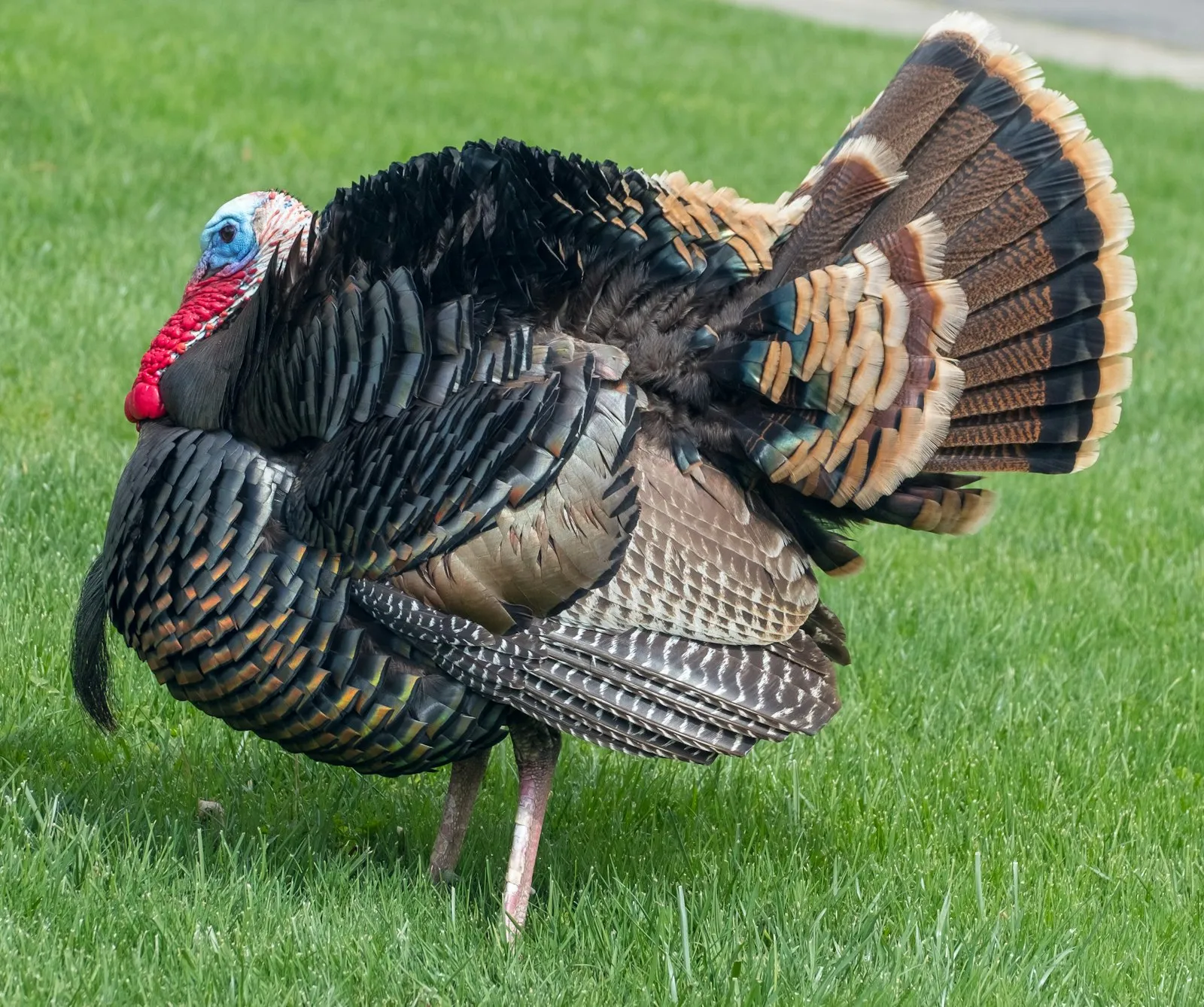
What do wild turkeys eat? Mostly plants: acorns and other nuts, seeds, grain, berries, buds, leaves, and roots. The National Wild Turkey Federation puts an adult’s diet at about 85% plant matter and 15% animal matter, and that animal share is mostly insects, snails, and spiders, with the occasional salamander, frog, or snake. Baby turkeys (poults) are the exception: for their first weeks they live mainly on insects.
This guide covers the wild turkey diet season by season, what poults need, how the menu changes across regions, and the question most readers actually have when a flock shows up under the bird feeder: should you feed them? (The short answer from every state wildlife agency we checked is no, and we explain why.) Species facts come from Cornell Lab of Ornithology’s All About Birds unless another source is named.
TL;DR
- Wild turkeys are omnivores that eat mostly plants, about 85% by the NWTF’s estimate: acorns, beechnuts, hickory nuts, seeds, grain, berries, buds, and greens.
- Acorns are the favorite. Audubon notes turkeys are usually found near some kind of oak.
- The diet follows the season: nuts from fall into early spring, greens and bulbs in spring, grass seed, berries, and insects in summer.
- Poults eat insects, spending nearly 90% of their waking hours feeding in their first summer.
- Winter is not an emergency. Healthy wild turkeys can go up to two weeks without food, per New York DEC.
- Don’t feed them. Massachusetts, Florida, Minnesota, and New York wildlife agencies all advise against it, because fed turkeys become bold and sometimes aggressive.
- If turkeys are eating spilled seed under your feeders, clean up the spill, switch to no-mess seed, and haze them away.
What do wild turkeys eat? The full menu
Wild turkeys are generalists. The Audubon field guide describes them as omnivorous, with a diet that “varies with season but is mostly plant material.” Here is what that looks like in practice.
| Food group | Examples | When it matters most |
|---|---|---|
| Nuts (hard mast) | Acorns from red, white, chestnut, and black oaks; American beechnuts; hickory nuts; pecans | Fall through early spring |
| Fruit (soft mast) | Wild black cherries, blackberries, huckleberries, grapes | Summer and fall |
| Seeds and grain | Sedge and grass seed, white ash seed, wheat, chufa, waste grain in harvested fields | Summer (wild seed), winter (waste grain) |
| Green plant parts | Leaves, buds, grass blades, roots, bulbs | Spring, and deep-snow winters |
| Insects and other invertebrates | Beetles, grasshoppers, leafhoppers, larvae, spiders, snails | Late spring and summer; poults all summer |
| Small vertebrates (occasional) | Salamanders, frogs, lizards, snakes | Whenever one turns up |
Sources: Cornell Lab, Audubon, and NWTF.
Acorns and other nuts
Nuts are the backbone of the turkey year. In fall, winter, and early spring, Cornell says turkeys scratch the forest floor for acorns, beechnuts, pecans, and hickory nuts. It’s the same acorn crop that blue jays famously cache, so a good oak year feeds both birds.
Seeds, grass, and grain
In late spring and summer, turkeys strip seeds from sedges and grasses. The NWTF adds wheat and chufa (a sedge with edible tubers). In farm country, harvested fields are a major food source: Minnesota DNR reports that studies in Wisconsin, Iowa, and Ohio found turkeys in crop fields were eating mainly waste grain and rarely caused significant crop damage.
Fruit and greens
Turkeys will climb into shrubs and low trees to reach fruit, per Cornell. Blackberries, cherries, huckleberries, and grapes are regulars. Audubon’s list also includes leaves, buds, grass blades, roots, and bulbs.
Insects and the occasional snake
Animal food is a minority of the diet but an important one. NWTF lists larvae, grasshoppers, and beetles; Audubon adds spiders and snails, plus the occasional frog, lizard, snake, salamander, or even a crab. Florida FWC’s list includes worms and small reptiles.
How wild turkeys find their food
Turkeys forage mostly on foot. They walk in flocks, scratch through leaf litter to expose food, and pick it up off the ground, according to Audubon, which also notes they may forage most actively in early morning and evening. Cornell’s tip for finding them follows from that: get up early, when flocks are often out foraging in clearings, field edges, and roadsides.
They cover ground while they do it. The NWTF says wild turkeys generally move a mile or two a day, depending on how far apart food and water are, and an annual home range runs from 370 to 1,360 acres. Like most birds, they swallow grit to help digest their food.
What wild turkeys eat by season
The menu tracks what’s available, and that changes sharply through the year.
Fall: the nut harvest
Fall is acorn season. Turkeys scratch the forest floor for newly dropped acorns, beechnuts, hickory nuts, and pecans, plus wild black cherries and white ash seeds, per Cornell. Flocks grow at the same time: as poults mature, Cornell notes, hens and their broods band together, and winter groups sometimes exceed 200 birds.
Winter: buried nuts, buds, and waste grain
Turkeys keep eating fallen nuts through winter. When deep snow covers the ground, Cornell says they switch to hemlock buds, evergreen ferns, the spore-covered fronds of sensitive fern, club mosses, and burdock.
New York DEC adds the farm-country picture: winter flocks shrink their range and often feed on waste grain and spread manure in valley farm fields. Turkeys can scratch through 4 to 6 inches of snow, may sit out a severe storm on the roost for a week or more, and healthy birds can live up to two weeks without food. That’s why the agency says winter feeding is “generally not recommended nor needed.” For the songbirds that do benefit from a winter feeder, see our guide to feeding birds in winter.
Spring: greens, bulbs, and the first insects
Fresh greens and buds, both on Audubon’s list of turkey foods, become available as plants leaf out. If last year’s nuts are scarce, Cornell notes turkeys may dig up plant bulbs. Insects return as the weather warms. Spring is also breeding season (early April through early June in New York, per DEC), when toms gobble and strut for hens.
Summer: grass seed, berries, and bugs
Summer is the season of seeds and insects. Cornell describes turkeys stripping seeds from sedges and grasses and adding salamanders, snails, ground beetles, and other insects. Blackberries and other soft fruit ripen through summer, and the hens are leading broods of poults through grassy openings full of insects.
What do baby wild turkeys (poults) eat?
Poults eat mainly insects. In New York, DEC says hens lay 10 to 12 eggs that hatch after 28 days, usually in late May or early June, and the hen then leads her brood into grassy or herbaceous areas where insects are abundant. The chicks leave the nest soon after hatching. Cornell says the hen feeds them for a few days until they learn to find food themselves; Minnesota DNR says they start foraging for insects right away.
Growth is fast, and it runs on protein. The NWTF reports that broods spend nearly 90% of their waking hours feeding during their first weeks and first summer, mainly on beetles, grasshoppers, and leafhoppers.
Research summarized by Dr. Mike Chamberlain’s Wild Turkey Lab adds detail by age:
- About 1 week old: small, soft-bodied insects such as leafhoppers, plant bugs, and fly larvae on leaves. Young poults rarely catch large insects and can’t make up for a shortage of small ones.
- After about 2 weeks: bigger prey, including grasshoppers, crickets, and spiders.
- At any age: poults eat whatever insects are available rather than targeting particular kinds, so more insects means better-fed poults.
The best brood habitat, per the lab, is low, succulent vegetation that holds plenty of small insects and that poults can move through easily. If you find a poult on its own, our fledgling guide explains when a young bird actually needs help and how to find a licensed rehabilitator.
What do wild turkeys like to eat most?
Acorns. Audubon describes wild turkeys as “usually found near some kind of oak (acorns are a favorite food),” and Cornell’s advice for spotting turkeys is to watch forest edges with nut-bearing trees such as oak and hickory.
Favorites shift with supply, though. Cornell notes that when nuts are scarce in spring, turkeys may dig up plant bulbs instead. New York DEC notes that turkeys “can move long distances to find food, but will stay in a small area if food is locally abundant.” That one sentence explains a lot of backyard turkey problems: a yard with a reliable pile of seed under the feeder is exactly the kind of food source a flock will settle near.
Regional differences in the wild turkey diet
Wild turkeys live in every state except Alaska, plus parts of Mexico and southern Canada, so “what they eat” depends on where you are. This is what the sources show for each region; your local flock may differ.
| Region | Typical habitat | What that means for the diet |
|---|---|---|
| Northeast | Mature oak-hickory forest (Cornell); red oak, beech, cherry, and white ash | Acorns, beechnuts, cherries, ash seeds. In deep snow, hemlock buds and ferns (Cornell); in New York, winter flocks feed on waste grain and manure in farm fields (NY DEC). |
| Southeast and Florida | Forests with pine, magnolia, live oak, pecan, and hickory over huckleberry and blueberry understories (Cornell) | Pecans, acorns, and berries. Florida FWC lists leaves, grass, seeds, berries, insects, worms, snails, frogs, and small reptiles. |
| Midwest farm country | Cropland near woods | Waste grain after harvest, plus insects and weed seeds; studies in Wisconsin, Iowa, and Ohio found little real crop damage (Minnesota DNR). |
| Southern Plains and Southwest | Open grassy savannah with small oaks (Cornell); Rio Grande turkeys tied to riparian corridors and nearby shrublands (NWTF) | The least-documented region for diet. The NWTF notes that dry conditions in the West limit access to food and water. |
Feeders can matter a lot in the snowy north. In New Hampshire, near the northern edge of the range, the Forest Society’s Something Wild program reports that bird feeders are one of the main winter food sources for turkeys, alongside beechnuts and acorns on south-facing slopes and fruit under crabapple trees.
Should you feed wild turkeys in your yard?
No. This is one of the rare backyard questions where the official answer is unanimous. Every state wildlife agency page we checked says the same thing: don’t feed wild turkeys.
- MassWildlife: turkeys fed regularly by people become habituated and can develop bold or aggressive behavior, which “is very difficult to change.” Turkeys that repeatedly challenge or attack people “may ultimately have to be lethally removed.” The agency’s summary: turkeys “can survive and thrive eating natural foods and do not need handouts.”
- Florida FWC: feeding turkeys in residential areas “isn’t good for them.” It concentrates birds, builds up droppings, and increases contact between flocks, and fed turkeys have damaged cars and roosted on roofs and pool screens.
- Minnesota DNR: “Don’t feed turkeys. Keep wild things wild!” Yearling males (jakes) are the ones most likely to start chasing people, children, and pets.
- New York DEC: winter feeding is “generally not recommended nor needed.”
Cornell’s species page acknowledges that some people scatter birdseed or corn on their lawns to attract turkeys, and warns that it also brings in rodents. We side with the agencies. A turkey that learns your yard means food is the turkey most likely to end up in trouble, and it doesn’t need the food: MassWildlife says turkeys thrive on natural foods, and a flock covers a mile or two a day finding them.
What to do when turkeys eat from your bird feeders
Most backyard turkeys aren’t being fed on purpose. They’re cleaning up what songbirds drop, and MassWildlife says turkeys become common in residential areas wherever they can easily find food like seed from bird feeders. Here’s how to keep your feeders without feeding the flock.
- Shrink the spill. Birds sort through seed and fling what they don’t want onto the ground. A single-ingredient seed wastes far less than a filler-heavy mix, and hulled sunflower (no shells) skips the hull pile entirely. Our guide to the best bird seed covers both.
- Clean up under the feeders. Rake up spilled seed and hulls every week or two, and fill feeders with only what birds finish in a day or two while turkeys are visiting.
- Stop ground feeding. Skip seed scattered on the lawn and low platform trays while turkeys are around. Cracked corn is the worst offender: it draws turkeys and rodents, and Cornell warns that corn is the bird food most likely to carry aflatoxins and should never be allowed to get wet.
- Take the feeders down for a few weeks if the flock keeps coming. The National Wildlife Federation’s advice is blunt: if turkeys are cleaning up spilled seed from songbird feeders, take those feeders down. Without easy food, a flock has less reason to stay: NY DEC notes turkeys settle into a small area when food there is abundant.
- Haze bold birds. MassWildlife recommends standing your ground or moving toward the turkeys, keeping them in front of you, and never turning your back or running. The NWF suggests a broom, a rake, or a spray from the garden hose.
- Get the neighbors on board. Florida FWC notes that hazing works far better when everyone on the street stops feeding and chases turkeys off.
- Plant instead of pour. If you have a large yard near woods, Cornell suggests nut-bearing or berry trees. MassWildlife recommends native plants, shrubs, trees, and a water feature to attract birds without the turkey problems. The NWF suggests a bird bath set directly on the ground for turkeys; our bird bath guide covers setup for every other bird too.
Wild turkeys vs. farm turkeys: what domestic turkeys eat
If you searched “what do turkeys eat” because you’re raising a few birds, the answer is different. Domestic turkeys raised for meat eat formulated feed, not acorns. The Cooperative Extension guide to raising meat turkeys in small or backyard flocks says commercial varieties grow fast and need a high-protein diet: turkey starter of about 28% protein (as crumbles) for the first four weeks, then grower feed of about 26%. Chicken starter and grower feeds are too low in protein for turkeys.
The two kinds of turkey don’t mix well. Cornell notes that early efforts to restore wild populations by releasing farm turkeys failed because those birds didn’t survive; wild birds were trapped and moved instead, starting in the 1940s. Minnesota DNR adds that releasing pen-reared turkeys is illegal there and risks spreading disease to wild flocks.
What to skip
- Corn or birdseed scattered for turkeys. It habituates the flock and draws rodents, and corn carries an aflatoxin risk (Cornell).
- Bread and kitchen scraps. Low-nutrition filler for any bird, and still a handout. Our can birds eat bread guide explains the problem.
- Winter “rescue” feeding. Healthy turkeys can go two weeks without food and scratch through 4 to 6 inches of snow (NY DEC).
- Chicken feed for farm or pet turkeys. It’s too low in protein for poults (Cooperative Extension).
- Releasing pen-reared or pet turkeys. It’s illegal in Minnesota and risks disease in wild flocks.
- Counting on turkeys for tick control. Maine’s wildlife agency calls their effect on ticks roughly net zero.
- Blaming turkeys for crop damage on sight. Field studies found they mostly eat waste grain; Minnesota DNR says damage blamed on turkeys is sometimes caused by deer, raccoons, squirrels, or blackbirds.
- Hand-feeding or approaching a turkey for a photo. MassWildlife says boldness develops when turkeys repeatedly get food close to people.
FAQ
These answers are also marked up as FAQ structured data on the page.
What can I feed a wild turkey in my yard? Nothing, per every state agency we checked. Plant nut or berry trees instead, and keep spilled feeder seed cleaned up.
What is a wild turkey’s favorite food? Acorns. Audubon notes wild turkeys are usually found near oaks; beechnuts, hickory nuts, pecans, and wild cherries follow close behind.
What do wild turkeys eat in the winter? Nuts and seeds scratched out of the leaf litter, waste grain in farm fields, and, under deep snow, hemlock buds, ferns, and club mosses. They can go up to two weeks without food.
Is it illegal to feed wild turkeys? It depends on your state and town. The four state agencies we checked all discourage it; check local rules before you put anything out.
Do wild turkeys eat ticks? Some. Maine’s wildlife agency describes the overall effect on ticks as about net zero.
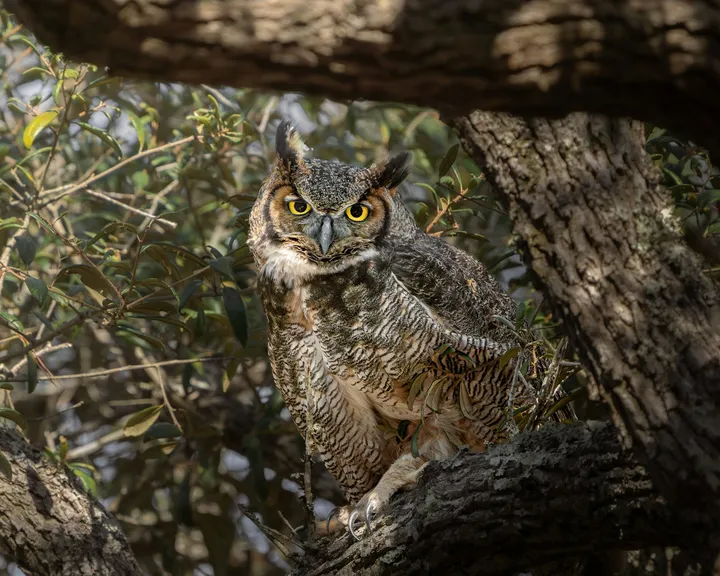
What is the biggest predator of wild turkeys? Coyotes, bobcats, raccoons, mountain lions, Golden Eagles, and Great Horned Owls all take turkeys, per Cornell. Our guide to what owls eat covers the owl side.
Is it good to have wild turkeys in your yard? Passing flocks, yes. Flocks that settle in because someone feeds them bring droppings, damage, and aggressive birds.
What to do this week
It’s November: acorns are down, and winter flocks are forming. If turkeys are visiting your feeders, rake up the spilled seed this weekend, switch any filler-heavy mix to plain sunflower or hulled sunflower, and stop tossing seed on the ground. If they keep coming, pull the feeders for a few weeks and let the flock go back to the oaks. Then plan for spring: an oak, a hickory, or a few native berry shrubs will feed turkeys and jays for decades without teaching anything to beg.
Sources
- Cornell Lab of Ornithology, All About Birds: Wild Turkey Life History (seasonal diet, foraging, habitat by region, predators) and Wild Turkey Overview (backyard tips, winter flock size, reintroduction history); Feeding Birds: A Quick Guide to Seed Types (corn and aflatoxins)
- Audubon Field Guide: Wild Turkey (omnivorous diet, foraging behavior, acorns as a favorite food)
- National Wild Turkey Federation: Wild Turkey Behavior (85/15 plant-to-animal diet, poult feeding, soft and hard mast, home range) and Rio Grande Subspecies Hunt Guide (range and habitat)
- Wild Turkey Lab: Importance of Insects to Wild Turkeys (poult insect diet by age)
- MassWildlife: Prevent conflicts with turkeys
- Florida Fish and Wildlife Conservation Commission: Living with Wild Turkeys
- Minnesota DNR: Turkeys (poult foraging, crop-field studies, feeding and release guidance)
- New York State DEC: Wild Turkey (nesting timeline, winter feeding and survival)
- Maine Department of Inland Fisheries and Wildlife: The Tick and Turkey Debate
- Society for the Protection of New Hampshire Forests: Something Wild: Do You Have Turkeys at your Feeder?
- National Wildlife Federation: 6 Tips for Feeding Wild Turkeys with Your Garden
- Cooperative Extension: Raising Meat Turkeys in Small or Backyard Flocks