An owl nest box only works if it matches an owl that already lives near you. For most backyards that means a screech-owl box, which Cornell Lab’s NestWatch program specifies with a 3-inch entrance hole, an inside depth of about 17 3/8 inches, and a mounting height of 10 to 30 feet. Barred Owl boxes are far bigger and belong in mature woods near water; Barn Owl boxes belong near open fields. Whichever owl you’re building for, hang the box this fall or early winter, because owls choose nest sites in late winter and some start laying in February.
Every dimension below comes from NestWatch’s species pages unless another source is named. The box recommendations are boxes whose published specs match those numbers.
TL;DR
- Pick the box for the owl you have. Screech-owl box for most yards (3-inch hole). Barred Owl box only for mature forest near water (7-inch hole). Barn Owl box only near open farmland or fields. Great Horned Owls don’t use boxes.
- Hang it between October and January. Owls court and choose sites in late winter. A box that goes up in April usually waits a year.
- Height: 10 to 30 feet for screech-owls, 12 to 15 feet for Barred and Northern Saw-whet Owls, 8 to 25 feet for Barn Owls.
- Add 2 to 3 inches of wood shavings. Owls don’t build nests; they lay eggs on whatever is in the cavity.
- Add a predator guard and skip the perch. NestWatch data shows guarded boxes succeed more often.
- Clean it once a year outside nesting season and keep your distance while owls are nesting.
- Skip rat poison, Barred Owl boxes in the Pacific Northwest, and any box whose hole size doesn’t match the spec.
Why a box works: owls can’t dig their own cavity
Cavity-nesting owls depend on holes something else made. Cornell Lab says the Eastern Screech-Owl never digs a cavity itself and relies on tree holes opened by woodpeckers, fungus, rot, or squirrels. The Barred Owl usually nests in a natural cavity 20 to 40 feet up in a large tree. A yard or woodlot without old, hollow trees gives them nowhere to nest, and a box fills that gap. Cornell puts it plainly for the screech-owl: tree cavities or nest boxes are essential, and the species readily recolonizes replanted areas, “especially if nest boxes are also provided.” (Leaving dead trees standing where they’re safe helps too; our guide to what woodpeckers eat covers how woodpecker holes become homes for other birds.)
Owls also don’t build nests. A female Eastern Screech-Owl lays her eggs on whatever debris sits at the bottom of the cavity and presses a body-shaped hollow into it. A female Barn Owl shreds her own regurgitated pellets into a cup. That is why every owl box gets a layer of shavings or chips before it goes up.
A box earns its keep outside nesting season, too. Audubon notes that screech-owls use nest boxes for roosting and storing prey year-round, and Cornell says you may spot one sunning itself in the entrance of a box on a cold, sunny day.
Which owls use an owl nest box (and where)
Eastern and Western Screech-Owls: the backyard owl box
These are the owls most people can realistically attract. According to Audubon, Eastern Screech-Owls live year-round mainly east of the Rocky Mountains, and Western Screech-Owls live in the southwestern, western, and northwestern states up into Alaska. Both are small, roughly 9 inches tall.
Eastern Screech-Owls are the easiest owl to get into a box. Cornell Lab says they “readily accept nest boxes,” including boxes built for Wood Ducks or Purple Martins, and that suburban pairs may fledge more young than rural ones, probably because their predators are scarcer in suburbs. Western Screech-Owls are pickier: Audubon says they use nest boxes less readily, and NestWatch suggests building with reclaimed, weathered wood because weathered boxes seem to be accepted more readily than new ones.
One honest note if you feed birds: biologist Fred Gehlbach, whose screech-owl research Audubon draws on, points out that backyard bird feeders “offer up small-feathered prey.” Cornell says Eastern Screech-Owls eat most kinds of small animals, including surprisingly large numbers of earthworms and insects, so a songbird from your feeder will occasionally be on the menu. Our guide to what owls eat breaks down each species’ diet. Screech-owls also drink and bathe at birdbaths, per Cornell, so a clean bath near the box helps; see our guide to attracting birds to a bird bath.
Barred Owl: big woods near water
Cornell Lab says Barred Owls “often take up residence in nest boxes in mature forests,” and that big bottomland forest along a river is prime habitat. NestWatch adds that the box should go within 200 feet of water if possible. If your property is a suburban lot without large trees nearby, a Barred Owl box is unlikely to be used.
Barred Owls stay put. Of 158 banded Barred Owls that were later found again, none had moved more than 6 miles, and Cornell notes they may scout a nest site as early as a year before using it. A Barred Owl box is a multi-year commitment.
Regional exception: Cornell Lab reports that Barred Owls have recently spread into the Pacific Northwest, where they are displacing and hybridizing with Spotted Owls, which are already threatened by habitat loss. If you live in Washington, Oregon, or northern California, don’t put up a Barred Owl box. A screech-owl box is the better choice there.
Barn Owl: farms and open country
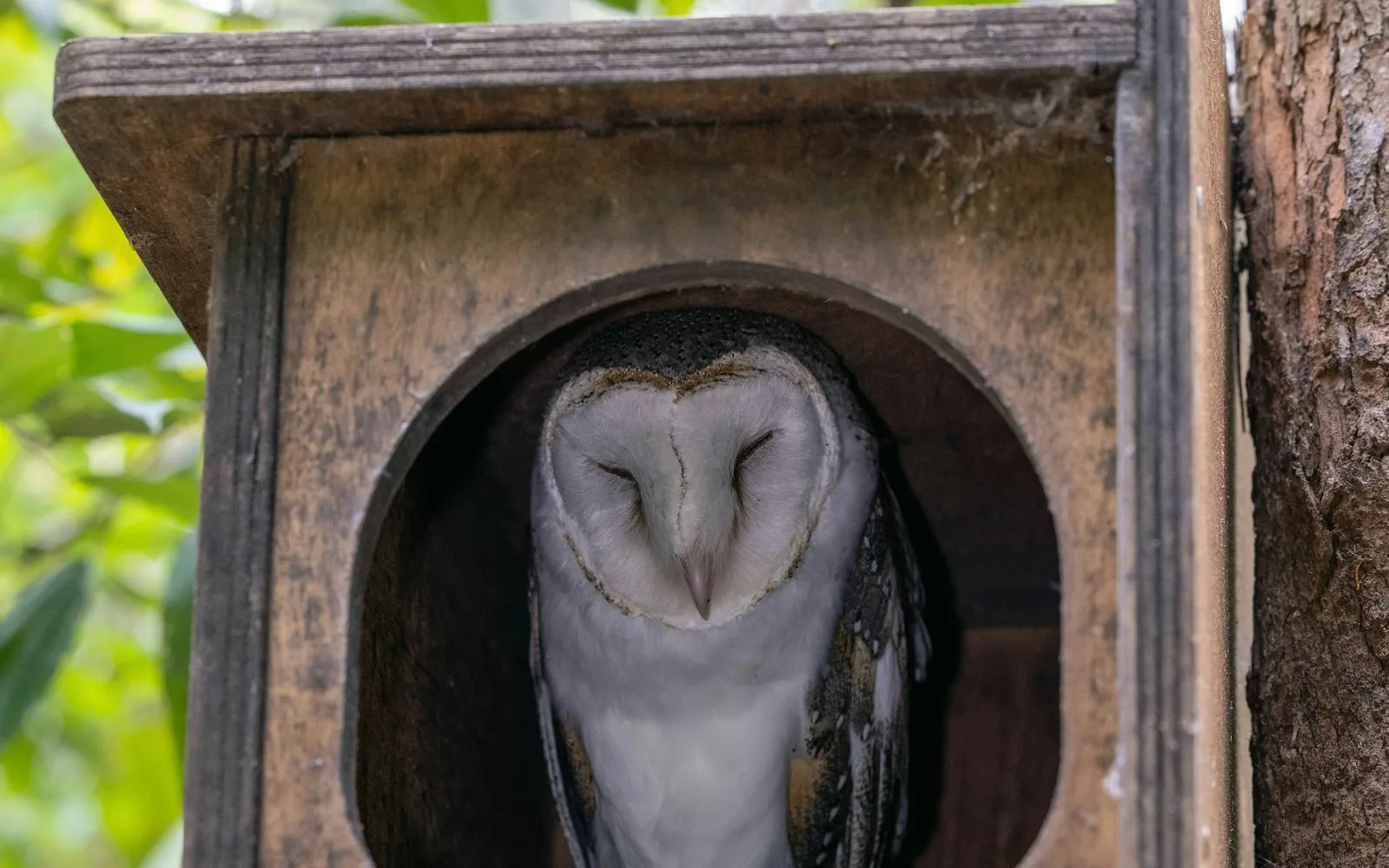
NestWatch says Barn Owls prefer open habitats such as agricultural fields, along with grassland, marsh, and desert. Boxes go in barns, silos, granaries, and church steeples, or on a free-standing pole. Cornell Lab lists clutches of 2 to 18 eggs and up to 3 broods a year, and NestWatch warns that hungry owlets are noisy, so don’t put the box too near your house.
A Barn Owl box makes sense on a farm, a vineyard, or acreage beside open fields. On a typical quarter-acre suburban lot, it’s the wrong box.
Northern Saw-whet Owl: northern conifer woods
The saw-whet uses the same box as a screech-owl: NestWatch gives identical 3-inch hole and interior dimensions, but a lower mounting height (12 to 15 feet) and a south-facing entrance. NestWatch says saw-whets prefer coniferous forest near a river or swamp. If you have that habitat, a screech-owl box may attract either species.
Owls that won’t use a box
Great Horned Owls don’t nest in boxes. Cornell Lab says they usually adopt a stick nest built by another species, such as a Red-tailed Hawk or crow. NestWatch’s alternative is a woven nest cone placed 15 to 45 feet up in a live hardwood at least 12 inches in diameter, and its own instructions say to “have an arborist install the cone.” That is a project for landowners with big trees, not a weekend box.
Owl nest box dimensions by species
These are NestWatch’s numbers for each species. “Depth” is the inside depth of the box, measured from floor to roof.
| Owl | Entrance hole | Width x length (inside) | Depth (inside) | Mount height | Facing | Space boxes |
|---|---|---|---|---|---|---|
| Eastern Screech-Owl | 3 in round | 9 5/8 x 11 1/4 in | 17 3/8 in | 10-30 ft | Any | 100 ft |
| Western Screech-Owl | 3 in round | 9 5/8 x 11 1/4 in | 17 3/8 in | 10-30 ft | South or east | 1,000 ft |
| Northern Saw-whet Owl | 3 in round | 9 5/8 x 11 1/4 in | 17 3/8 in | 12-15 ft | South | 800 ft |
| Barred Owl | 7 in | 13 x 13 in | 23 in | 12-15 ft | Any | 1/2 mile |
| Barn Owl | 3 3/4 x 4 1/2 in oval | 12 3/8 x 22 3/4 in | 16 in | 8-25 ft | Any | 100 ft |
| Great Horned Owl | Nest cone, no box | n/a | n/a | 15-45 ft | n/a | 1 1/2 miles |
A few notes on the table:
- The 3-inch hole is the important number. Northern Woodlands, summarizing the NestWatch plan, notes that a hole too small keeps adult owls out and one too large lets raccoons in.
- Floor size is less critical. Gehlbach tested three screech-owl box designs and, as Audubon reports, found an 8-inch-square floor “just fine.” Audubon’s plan puts the bottom of the hole 10 inches above the floor.
- Listings give outside measurements. With 3/4-inch walls, a box’s inside is about 1 1/2 inches narrower than its outside dimensions, so compare carefully.
- The screech-owl box fits more than screech-owls. Northern Woodlands notes the same design also suits saw-whets, Boreal Owls, and American Kestrels.
When to put up an owl nest box
Put it up in fall or early winter, before owls start courting and choosing sites. NestWatch’s nesting calendars (drawn from Cornell’s Birds of the World) show when most nesting happens across each species’ range:
| Owl | Peak nesting (most of range) | Have the box up by |
|---|---|---|
| Great Horned Owl (cone) | Late February to mid-April; some from late December | Fall, so owls find it by January (NestWatch) |
| Barn Owl | Mid-February to late July; some nesting in most months | December, which NestWatch calls a good time to clean Barn Owl boxes |
| Eastern Screech-Owl | Early March to early June | December in the Northeast (Northern Woodlands); earlier is better in the South |
| Western Screech-Owl | Late March to early June | January (NestWatch) |
| Barred Owl | March to July; some in January and February | Fall, ideally a full season ahead, since they scout sites a year early |
| Northern Saw-whet Owl | Late March through June | Winter |
Regional honesty on screech-owls: Audubon says Eastern Screech-Owls begin nesting in February in southern states but may wait until July in far northern habitats. A box hung in November is on time everywhere. A box hung in March may still catch a northern pair but is likely late for a southern one.
If you miss the window, put the box up anyway. NestWatch recommends leaving Western Screech-Owl boxes open all winter for roosting, and an owl that roosts in a box over the winter has already found it by spring. For more on what birds need through the cold months, see our guide to feeding birds in winter.
Where to hang an owl nest box
Height
Use the NestWatch range for your species: 10 to 30 feet for screech-owls, 12 to 15 feet for Barred and saw-whet Owls, 8 to 25 feet for Barn Owls. Within those ranges, go toward the low end unless you have a reason not to. A screech-owl box at 10 to 15 feet is fully within spec, and you will need to reach it with a ladder once a year to clean it.
Which direction an owl box should face
Less important than most guides suggest. NestWatch lists “any” direction for Eastern Screech-Owls, Barred Owls, and Barn Owls; south or east for Western Screech-Owls; and south for saw-whets. The Ojai Raptor Center’s Barn Owl guide adds the practical version: think about where your storms come from and how much sun the box will take, then turn the hole away from both.
Habitat, flight path, and spacing
- Screech-owls: NestWatch says to place the box under a tree limb at the woodland edge, next to fields or wetlands, on a tree at least as wide as the box. A branch nearby gives the young something to climb out onto, as long as it doesn’t block the hole.
- Barred Owls: within 200 feet of water if you can, with no branches or leaves obscuring the entrance.
- Barn Owls: near open fields with a clear flight path. Ojai Raptor Center says to keep the box front “floating” away from limbs that raccoons, bobcats, or Great Horned Owls could use to reach in.
- Spacing: one box per territory is enough. NestWatch does suggest a second screech-owl box within a pair’s territory as a backup, because second nesting attempts almost always move to a new site.
Tree or pole? NestWatch prefers a pole with a predator guard, far enough from trees that squirrels can’t jump to it. A tree mount works with a Noel guard (below).
How to set up an owl box so owls move in
Add bedding
NestWatch’s amounts: 2 to 3 inches of wood shavings for screech-owls and saw-whets, and 3 to 4 inches of wood chips for Barred Owls. Barn Owls make their own lining from shredded pellets, so bedding is optional; NestWatch says about 3/4 inch of shavings is fine. Ojai Raptor Center advises against sawdust and straw, which hold moisture.
Add a predator guard, skip the perch
This step matters more than any other. NestWatch reports that in its nest records, boxes with predator guards had nesting success rates 6.7% higher than unguarded boxes (Bailey and Bonter, 2017), with cone baffles, stovepipe baffles, and entrance-hole extenders performing best. The three standard options, per NestWatch’s features of a good birdhouse:
- Cone baffle: a metal collar about 3 feet across, mounted on the pole under the box.
- Stovepipe baffle: about 8 inches in diameter and 24 to 36 inches long; the most effective and the most work.
- Noel guard: a wire-mesh tube on the front of the box. Use it on tree-mounted boxes, where a pole baffle isn’t an option.
If squirrels chew the entrance bigger, NestWatch suggests screwing a sheet-metal plate with a matching hole over the front. The same baffle logic keeps squirrels off feeders; our guide to keeping squirrels out of bird feeders covers baffle sizing in detail.
Leave the perch off. NestWatch says a perch is unnecessary for the birds and gives predators a foothold. Northern Woodlands suggests a flat perch inside, about 2 inches below the hole, for the young to use when they’re ready to leave.
Untreated wood, unpainted inside, a door that opens
NestWatch’s construction checklist, scaled to owls:
- Untreated, unpainted wood. Cedar, pine, or cypress, or for larger owl boxes, non-pressure-treated CDX exterior plywood. Don’t paint or stain the inside.
- Walls at least 3/4 inch thick for insulation.
- Galvanized screws, not nails or staples.
- A roof overhanging the front by 2 to 4 inches, which also makes it harder for raccoons and cats to reach in from above.
- Drainage holes in a recessed floor and ventilation holes near the top.
- A rough interior wall below the hole so nestlings can climb out.
- A side or front door you can open for cleaning.
Build or buy an owl nest box
Building one
A screech-owl box is a beginner-friendly build. Audubon’s screech-owl nest box plan uses one 1x10x8-foot cypress or cedar board (3/4 inch thick), two 1 1/2-inch exterior hinges, and about thirty 2-inch exterior deck screws. Key details from the plan: a 3-inch hole with its bottom 10 inches above the floor, 1/4-inch drain holes, and a floor recessed 1/2 inch to keep water out.
NestWatch offers free downloadable plans for every species on its pages (it asks for an email address). It rates the screech-owl and Barred Owl boxes “moderate” and the Barn Owl box “complex.”
Boxes that match the specs
We checked the published specs of widely sold owl boxes against NestWatch’s numbers. These came closest. Prices were checked November 3, 2026.
- Screech-owl (the box most readers need): the Coveside Saw-Whet and Screech Owl House, $88.99. It has the 3-inch hole, is eastern white pine, measures about 11 x 9 x 17 3/4 inches outside, and comes with a built-in entrance guard. Coveside’s Kestrel & Screech Owl House ($79.99) has nearly the same dimensions but adds a 5-inch outside perch; remove it before you hang the box.
- Barred Owl: the JCS Wildlife Barred Owl Nesting Box, $133.96. It has a 7-inch oval hole, a 13 x 13 inch body 26 inches tall, the hole 16 1/2 inches above the floor, a side clean-out door, and exterior plywood finished with linseed oil.
- Barn Owl (farms and acreage only): the Amador Barn Owl Nesting Box, $259, all wood with an internal baffle and a side door. In Southern California, the Ojai Raptor Center’s barn owl box ($320, pickup only in Oak View) supports a raptor rehabilitation nonprofit. Neither lists its hole size online, so ask before you buy.
None of these is a must-buy. If you’re handy, the Audubon plan gets you a spec-correct screech-owl box from one board.
What to check before you buy
- The hole size matches the table above. If a listing doesn’t state it, ask the seller or pick another box.
- The size is close to spec, remembering that listings usually give outside dimensions.
- No outside perch, or one you can remove.
- Unfinished interior, drainage, ventilation, and a door that opens.
Some popular boxes miss on these points. Duncraft’s $139.95 Bird-Safe Screech Owl Nesting Box lists a “slotted entry hole, measuring 7 x 4 inches,” far from NestWatch’s 3-inch round hole. JCS Wildlife’s poly-lumber screech-owl box uses a 3 1/2-inch hole, half an inch wider than the spec, in a box 14 inches tall overall.
Cleaning and checking your owl box
Clean once a year, when owls aren’t nesting. NestWatch suggests December for Barn Owls, and Ojai Raptor Center says November through January, sweeping out pellets, feathers, and debris (soap and water aren’t necessary). For saw-whets, NestWatch says the hard mat of dried prey remains can make a box unusable for a year or two, so cleaning matters. Add fresh shavings afterward.
Look for signs of use from the ground. Ojai Raptor Center lists wear on the bottom of the entrance hole, feathers around the box, and pellets on the ground below. It adds that Barn Owls usually hunt one to two hours after dusk and an hour before sunrise, so those are the times to watch.
Keep your distance while owls are nesting. NestWatch says screech-owl and saw-whet females may abandon a nest if disturbed early in the nesting cycle, so it advises waiting at least one week, and preferably two, after finding a nest before checking the contents. Barn Owls are very sensitive during early nesting (April to May in NestWatch’s guidance). Cornell Lab notes that Barred Owl females defend nests aggressively and sometimes strike intruders with their feet. Binoculars from a distance are the better way to check.
Owls are federally protected. The Migratory Bird Treaty Act prohibits killing, capturing, or transporting protected birds, owls included, without federal authorization. Leave an occupied box alone, and if you want to move a box, NestWatch’s advice is to wait until breeding season is over. If you find an owlet on the ground below the box, call a licensed wildlife rehabilitator before touching it; our fledgling guide explains how to find one.
What to skip
- Rat poison and bait boxes. An owl that eats a poisoned rodent eats the poison. A study of 161 hawks and owls, including Barred, Eastern Screech, and Great Horned Owls, brought to a Massachusetts wildlife clinic found rodenticide residue in 86% of them, and 6% died of it. A follow-up covering 2012 to 2016 found second-generation rodenticides in 96% of birds tested, and the three that pest-control professionals used most showed up together in most of the birds. Ojai Raptor Center asks buyers to remove all rodenticides, bait boxes included, at least a month before installing a box. If a pest company services your property, ask what it uses.
- A Barred Owl box in the Pacific Northwest. See the regional exception above.
- A Barn Owl box on a small lot or near a bedroom. The owlets are loud and the box needs open country.
- A “Great Horned Owl box.” They don’t use boxes. A nest cone in a big hardwood, installed by an arborist, is the real option.
- Perches, paint, and pressure-treated wood.
- Checking the box during egg-laying. Watch from the ground instead.
- Feeding or baiting owls. Audubon is firmly against it; our owl diet guide explains why.
- Giving up after one season. Northern Woodlands notes that it may take years for a box to attract a screech-owl pair. A box in good habitat earns a few seasons before you move it.
FAQ
How high should an owl box be? It depends on the owl. NestWatch recommends 10 to 30 feet for Eastern and Western Screech-Owls, 12 to 15 feet for Barred and Northern Saw-whet Owls, and 8 to 25 feet for Barn Owls. The lower end is easier to clean, and a screech-owl box at 10 to 15 feet is fully within spec.
What is the best time of year to put up an owl box? Fall to early winter, October through January. NestWatch says to install Western Screech-Owl boxes by January, and Audubon notes Eastern Screech-Owls begin nesting in February in the South. A box hung in spring is usually a season late, though owls may still roost in it.
What are the dimensions of a barred owl nest box? A 7-inch entrance hole, a 13 x 13 inch interior, and an inside depth of 23 inches. Mount it 12 to 15 feet up, ideally within 200 feet of water, with 3 to 4 inches of wood chips inside, and space boxes at least half a mile apart.
Will a barred owl use an owl box? Yes, in mature forest. Cornell Lab says Barred Owls often take up residence in nest boxes there, and may scout a site a year before using it. A box on a suburban lot without big trees nearby is unlikely to be used, and in the Pacific Northwest you shouldn’t put one up at all.
Do owls come back to the same nest every year? Often. Western Screech-Owls may use the same cavity several years running, Barn Owl sites are often reused (sometimes by different owls), and Barred Owls rarely move more than a few miles. Great Horned Owls are the exception: their borrowed stick nests fall apart and are seldom reused.
Which direction should an owl box face? Any direction works for Eastern Screech-Owls, Barred Owls, and Barn Owls, per NestWatch. Face Western Screech-Owl boxes south or east and saw-whet boxes south. A clear flight path matters more than the compass.
Do owl boxes really attract owls? Most reliably for Eastern Screech-Owls, which Cornell Lab says readily accept nest boxes. Western Screech-Owls use them less readily, per Audubon. Plan on two or three breeding seasons before judging a well-placed box.
What to do this week
Figure out which owls you have. If you hear owls at night but don’t know which ones, Merlin can identify them from a recording. For most readers, the answer is a screech-owl: build one from the Audubon plan or buy a spec-correct box, put it on a pole with a baffle (or a tree with a Noel guard) 10 to 15 feet up at the edge of your trees, add 2 to 3 inches of pine shavings, and have it up by December. Then pull any rodent bait off the property and leave the box alone until spring.
Sources
- Cornell Lab of Ornithology, NestWatch, Right Bird, Right House: Eastern Screech-Owl, Western Screech-Owl, Northern Saw-whet Owl, Barred Owl, Barn Owl, and Great Horned Owl (dimensions, heights, facing, spacing, nesting calendars, tips)
- NestWatch: Features of a Good Birdhouse and Dealing with Predators (construction, predator guards, Bailey and Bonter 2017)
- Cornell Lab of Ornithology, All About Birds: Eastern Screech-Owl, Barred Owl, American Barn Owl, Western Screech-Owl, and Great Horned Owl (nest sites, nesting facts, range notes)
- Audubon: How to Build a Screech-Owl Nest Box (ranges, nesting timing, Gehlbach’s box research, build plan)
- Ojai Raptor Center: Barn Owl Box Guide (installation, cleaning, signs of use)
- Northern Woodlands: How to Make an Owl Box (screech-owl box siting and timing in the Northeast)
- Murray, M. (2011), Journal of Zoo and Wildlife Medicine: rodenticide exposure in four species of birds of prey in Massachusetts, 2006-2010; Murray, M. (2017), Ecotoxicology: the 2012-2016 follow-up
- U.S. Fish & Wildlife Service: Migratory Bird Treaty Act of 1918