A hummingbird nest is one of the hardest things to find in a backyard, not because they are rare but because they are the size of half a walnut shell, camouflaged with lichen, and tucked high on a slender branch under a canopy of leaves. This guide covers what a hummingbird nest actually looks like, where hummingbirds build them, when they raise young, why you almost never find one, and what to do if you do.
If you have read our hummingbird migration guide, you know the spring arrival is just the start. After the migrants settle in and males establish territory, females get to work building nests and raising the next generation. This is the nesting side of the story.
TL;DR
A hummingbird nest is about 1.5 inches across, the size of half a walnut shell, built by the female from plant down and spider silk and camouflaged with lichen. Hummingbirds nest 10 to 40 feet up on slender, downward-sloping tree branches, never in birdhouses. Nesting runs spring through midsummer; the female lays 2 pea-sized eggs, incubates about 14 to 18 days, and chicks fledge in roughly 3 weeks. Many females raise 2 broods. If you find a nest, leave it completely alone; it is protected by federal law.
What a hummingbird nest looks like
Size: half a walnut shell
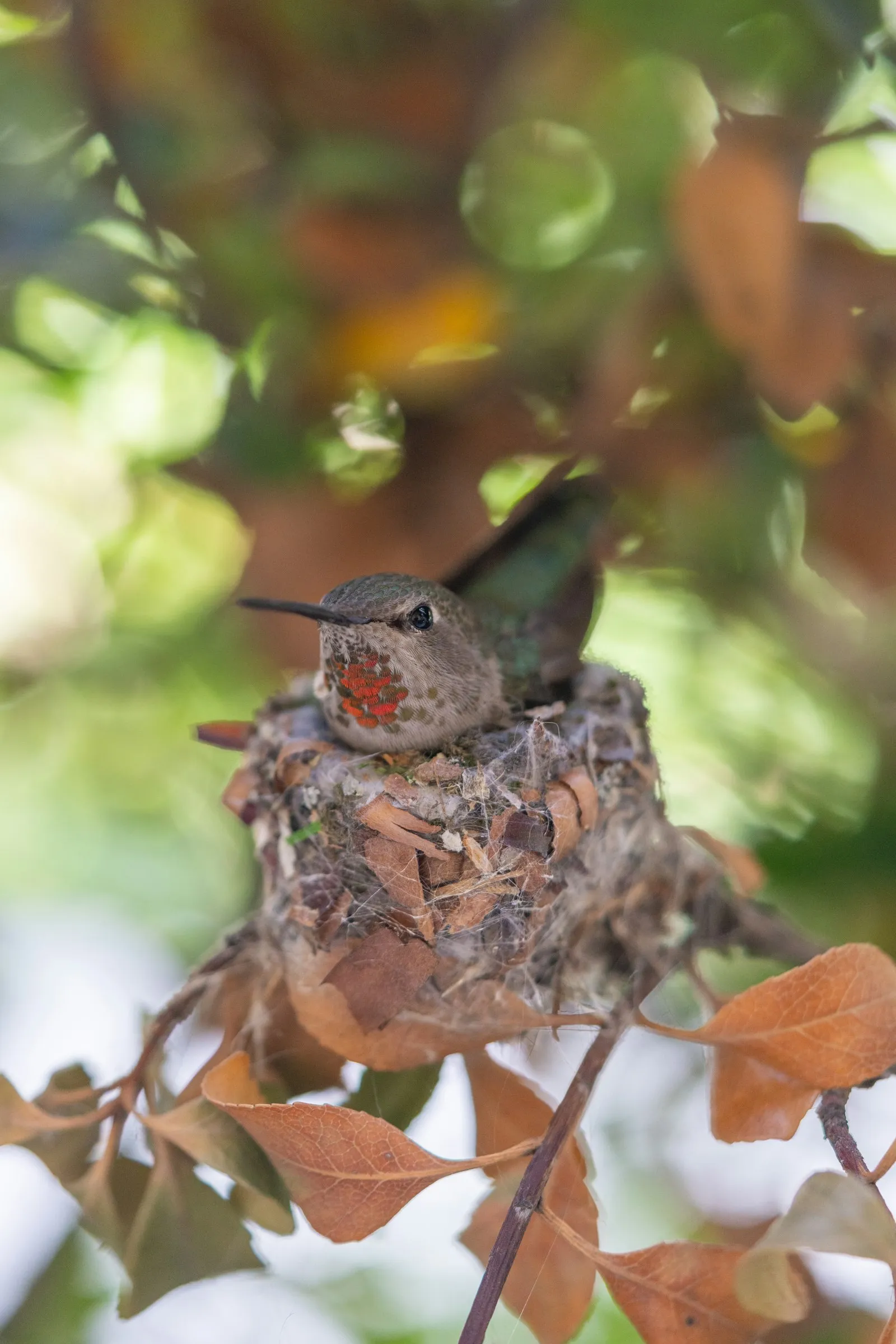
A typical hummingbird nest is about 1.5 inches in outside diameter with an inner cup roughly the size of a US quarter. That is small enough to sit comfortably on the end of your thumb. The two eggs inside are white and about the size of a navy bean or small pea. Cornell Lab’s Ruby-throated Hummingbird Life History documents the nest as roughly 2 centimeters across on the inside.
Materials: plant down, spider silk, lichen
The female builds the nest almost entirely from three materials:
- Plant down (the soft fluff from dandelions, thistle, cattail, or fern) forms the soft inner cup.
- Spider silk binds the plant down together and anchors the whole nest to the branch. This is the structural genius of the nest.
- Lichen flakes and bark bits are pressed onto the outside for camouflage, making the nest look like a natural knot or bump on the branch.
The spider-silk stretch engineering
The spider silk does more than hold the nest together. Because silk is elastic, the nest can stretch as the two chicks grow from pea-sized hatchlings to nearly adult size. A rigid nest would either be built too large (wasting energy and exposing eggs) or burst as the chicks grew. The silk solves this: the nest expands with its occupants. This is why females specifically harvest spider silk and why leaving spiders and their webs alone in your yard genuinely helps nesting hummingbirds.
Where hummingbirds nest
Height and branch position
Hummingbirds nest on thin branches, typically 10 to 40 feet off the ground, frequently on a downward-sloping limb. The nest is usually sheltered by a leafy branch directly above (protection from rain and midday sun) and often positioned over an open area: a path, a driveway, a stream, or a clearing. The open space below gives the female a clear flight path in and out.
Tree and shrub preferences
Common nesting trees include oak, birch, poplar, hackberry, and hawthorn, usually within reach of a reliable nectar source. The female chooses a site near flowers or feeders because she does all the feeding alone and cannot range far while incubating. If you keep a clean nectar feeder and native flowers, you make your yard a more viable nesting neighborhood.
Do hummingbirds nest in birdhouses?
No. This is one of the most common hummingbird misconceptions. Hummingbirds are open-cup nesters; they build on branches, not in cavities. Cornell Lab’s NestWatch confirms hummingbirds will not use birdhouses. Any product sold as a “hummingbird house” will not be used for nesting. The way to support nesting is habitat (flowers, feeders, spider silk), not a box.
Where they nest during the day vs at night
The nest is the nest, day and night, during the breeding period; the female sleeps on it while incubating. Outside of nesting, hummingbirds do not sleep in nests at all. They roost on twigs and can enter torpor (a deep, energy-saving sleep state) on cold nights, but that is roosting, not nesting. A nest is built solely to raise young.
When hummingbirds nest (the timeline)
Nesting season by region
Nesting tracks the same north-moving pattern as spring migration:
- Gulf Coast and Deep South: February to March
- Southeast and lower Midwest: March to April
- Mid-Atlantic, Great Lakes, New England: May to June
- Far north and high elevation: June into July
Anna’s Hummingbird on the Pacific Coast is unusual: it can nest as early as December and into spring because it does not migrate. Our hummingbird migration guide covers the regional timing in more detail.
Eggs, incubation, and fledging
- Eggs: 2 white eggs, pea-sized, laid a day or two apart
- Incubation: about 14 to 18 days, by the female only
- Nestling period: chicks fledge roughly 18 to 28 days after hatching
- Total: from egg-laying to fledging is roughly 5 to 7 weeks
The male plays no role in nest building, incubation, or chick rearing. The female does all of it alone, which is why she visits feeders so heavily during this period.
How many broods per season
Many female hummingbirds raise two broods in a single season, and some in warm climates raise three. A female will often start building a second nest while still feeding fledglings from the first brood, shuttling between the two. This is part of why a single yard can show nesting activity across several months.
Why you almost never find a hummingbird nest
Every element of a hummingbird nest is built to be invisible:
- Size: at 1.5 inches, it is smaller than the leaves around it.
- Camouflage: the lichen exterior makes it look like a natural bump on the branch.
- Placement: high on slender branches, sheltered by leaves, away from trunks where you would look.
- Behavior: the female builds alone, quietly, and approaches the nest on indirect flight paths to avoid revealing its location to predators.
Most people who feed hummingbirds for years never find a nest in their own yard, even when one is present. When people do find one, it is usually by accident, after noticing a female making repeated trips to the same branch. The PAA-flagged question “how rare is it to see a hummingbird nest” reflects exactly this: the nests are common, but seeing one is not.
The backyard hummingbird species and their nests
All North American hummingbirds build the same basic plant-down-and-spider-silk cup nest, with minor variations in size and placement. The 7 species you are most likely to encounter:
- Ruby-throated Hummingbird (eastern US): the default eastern nester; nest on downward-sloping deciduous branches. Cornell Lab overview
- Anna’s Hummingbird (Pacific Coast): nests very early, sometimes December to February; year-round resident. Cornell Lab overview
- Rufous Hummingbird (Pacific Northwest, breeds to Alaska): may nest in loose groupings. Cornell Lab overview
- Black-chinned Hummingbird (interior West): often nests near water. Cornell Lab overview
- Allen’s Hummingbird (California coast): similar to Rufous. Cornell Lab overview
- Broad-tailed Hummingbird (Rockies): nests at high elevation, often over streams. Cornell Lab overview
- Calliope Hummingbird (Pacific Northwest mountains): the smallest US bird builds a nest sometimes mistaken for a pine cone. Cornell Lab overview
Predators and threats to hummingbird nests
Despite the camouflage, hummingbird nests and chicks face real predators. Audubon’s Which Animals Prey on Hummingbirds? documents the main threats:
- Jays, crows, and other birds raid nests for eggs and chicks.
- Snakes climb to nests.
- Squirrels and chipmunks occasionally take eggs.
- Praying mantises are a surprising and real threat: large mantises can ambush and kill adult hummingbirds at flowers and feeders.
- Domestic cats kill adult hummingbirds and fledglings; keeping cats indoors protects nesting birds.
The female’s strategy against most of these is concealment, not defense. A well-hidden nest is the primary protection.
What to do if you find a hummingbird nest
Do not touch, prune, or disturb
If you are lucky enough to find an active nest, the rule is simple: leave it completely alone. Do not touch the nest, do not prune the branch, and do not trim surrounding foliage that shelters it. The female abandons easily if disturbed during building or early incubation, and abandoned eggs or chicks will not survive.
Keep your distance and keep cats in
Observe from at least 15 feet. Keep cats indoors for the duration of the nesting period. Avoid pointing hoses, leaf blowers, or ladders near the nest. Hummingbird nests and the birds are protected under the US Migratory Bird Treaty Act, so disturbing, moving, or destroying an active nest is illegal.
How to help without interfering
You cannot relocate or build a nest, but you can support a nesting female:
- Run a clean nectar feeder refreshed every 2 to 3 days (the female needs huge calorie intake).
- Plant native nectar flowers and keep them blooming.
- Provide a mister or shallow water source for bathing.
- Leave spiders and spider webs alone, since females harvest silk for nest building.
How to encourage hummingbirds to nest in your yard
You cannot make a hummingbird nest, but you can make your yard the kind of place a female chooses. The same things that attract hummingbirds to a feeder also make a yard nest-friendly:
- Reliable nectar (feeders plus native tubular flowers like bee balm, cardinal flower, trumpet vine, and salvia)
- Small deciduous trees and tall shrubs for nest sites
- A water source (mister, dripper, or shallow moving water)
- Undisturbed spider webs for silk
- No pesticides (hummingbirds eat small insects and spiders, especially while feeding chicks)
Get the feeder timing right for your region so nectar is available before and through nesting season.
What to skip
Buying a “hummingbird house.” They do not work. Hummingbirds never use enclosed structures. Save your money for native plants.
“Hummingbird nesting material” products with synthetic fibers or pet fur. Females use plant down and spider silk they gather themselves. Avoid offering dryer lint, synthetic fiber, or pet hair treated with flea medication, all of which can harm birds. If you want to help, plant native plants that produce seed down naturally.
Disturbing a nest to photograph it. Even brief disturbance can cause abandonment. Photograph only with a zoom lens from a distance.
Pruning trees in spring and early summer without checking. If you have hummingbirds, scan slender branches before any spring or summer pruning so you do not accidentally destroy a nest.
FAQ
What does a hummingbird nest look like? A hummingbird nest is about 1.5 inches across, the size of half a walnut shell or a large thimble. It is a tiny, deep cup made of soft plant down bound with spider silk and camouflaged on the outside with lichen flakes and bits of bark, which makes it blend into the branch. The spider silk allows the nest to stretch as the two chicks grow. From below, a hummingbird nest looks like a small knot or bump on a branch rather than an obvious bird nest.
Where do hummingbirds build their nests? Hummingbirds build their nests on slender, often downward-sloping tree branches, typically 10 to 40 feet off the ground, sheltered by leaves above and frequently over an open area like a path, driveway, or stream. They favor deciduous trees such as oak, birch, poplar, and hawthorn, usually near a reliable nectar source. Hummingbirds do not nest in birdhouses, nest boxes, or cavities; they are open-cup nesters that build on branches.
What month do hummingbirds have babies? Hummingbird nesting season runs from early spring through midsummer, varying by region. On the Gulf Coast and Deep South, females may nest as early as February or March. In the Mid-Atlantic and Midwest, nesting peaks in May and June. In the far north and at high elevation, nesting can extend into July. Females often raise two broods per season, so you may see nesting activity across several months in a single yard.
Do hummingbirds use birdhouses or nest boxes? No. Hummingbirds do not use birdhouses, nest boxes, or any enclosed cavity. Cornell Lab’s NestWatch confirms hummingbirds are open-cup nesters that build tiny nests on tree branches, not cavity nesters. Any product marketed as a hummingbird house will not be used for nesting. To support nesting hummingbirds, plant native nectar flowers, run a clean feeder, and leave spider webs alone (females use spider silk to build nests) rather than putting up a house.
How rare is it to see a hummingbird nest? Finding a hummingbird nest is genuinely rare, not because nests are uncommon but because they are nearly impossible to spot. At 1.5 inches across, camouflaged with lichen, placed high on slender branches and sheltered by leaves, a hummingbird nest looks like a bump on a branch. Females also build alone and quietly. Most people who feed hummingbirds for years never find a nest in their own yard even when one is present. Spotting one usually happens by accident when you notice a female making repeated trips to the same branch.
Should I touch or move a hummingbird nest I found? No. Never touch, move, or prune around an active hummingbird nest. The female incubates and feeds alone and abandons easily if disturbed during nest building or early incubation. Hummingbird nests are protected under the US Migratory Bird Treaty Act, making it illegal to disturb, move, or destroy an active nest. Observe from at least 15 feet, keep cats indoors, and do not trim the branch or surrounding foliage until the chicks have fledged and the nest is confirmed empty for the season.
What to do this week
If you want to support nesting hummingbirds:
- Keep a clean nectar feeder up and refresh it every 2 to 3 days through nesting season.
- Plant or maintain native tubular flowers near small trees and tall shrubs.
- Leave spider webs alone in corners of your yard; females need the silk.
- Hold off on spring and early-summer tree pruning until you have scanned for nests.
If you found a nest:
- Step back to at least 15 feet and keep cats indoors.
- Do not touch the nest, prune the branch, or trim nearby leaves.
- Observe and enjoy it from a distance; photograph only with a zoom lens.
- Wait until the season is over and the nest is confirmed empty before any pruning.
The hummingbird nest is a small engineering marvel: a thimble of plant down and spider silk that stretches to hold a growing family, camouflaged so well you will probably never find the one in your own yard. The best thing you can do is keep the habitat healthy, the feeders clean, and the spiders undisturbed, and let the female do what she has been doing for millions of years. For the bigger picture on hummingbird care across the year, start with our hummingbird migration guide and how long backyard birds live.