Northern Cardinals are the most-photographed backyard bird in the eastern half of North America, and they are also one of the easiest to attract once you know what you’re doing. The food is forgiving (black-oil sunflower seed works almost everywhere), the feeder type matters more than most people realize (cardinals can’t use small-perch tube feeders), and the placement is what separates yards that get one or two cardinals from yards that host a breeding pair year-round. This is how to attract cardinals to your yard: range, food, feeder, placement, water, shelter, and what to skip.
Quick answer
To attract Northern Cardinals: offer black-oil sunflower seed and safflower in a wide-perch platform or hopper feeder placed 4 to 5 feet off the ground within 10 feet of dense shrubs or a low tree. Add a shallow water source. Cardinals are year-round residents across the eastern and southern U.S.; expect a new feeder to be discovered within 1 to 3 weeks. Feed at dawn and dusk when cardinals are most active.
Cardinal range: do you actually have cardinals?
Before optimizing your feeder setup, confirm Northern Cardinals are in your area. Per the Cornell Lab All About Birds Northern Cardinal range map, they live year-round across:
- The eastern half of the U.S., from the Atlantic coast west to roughly the eastern edge of the Great Plains (so: all of New England, Mid-Atlantic, Southeast, Midwest, and the eastern Great Plains states are full range)
- The Desert Southwest (southern Arizona, southern New Mexico, west Texas), where they overlap with the Pyrrhuloxia, the closely related “desert cardinal” with gray plumage and a yellow beak (Cornell Lab: Pyrrhuloxia)
- Parts of south-central Canada (southern Ontario, southern Quebec, expanding in recent decades as cardinals have shifted their range northward, partly attributed to backyard feeding)
If you live in the Pacific Northwest, the high Mountain West (Wyoming, Montana, Idaho, much of Utah), or most of Canada north of about the 49th parallel, you do not have Northern Cardinals. No feeder setup will bring them; they aren’t there. The Audubon Field Guide entry on the Northern Cardinal covers the range and habitat in detail.
For everyone else, the rest of this article is for you.
What cardinals eat (the food list, ranked)
Cardinals have thick, conical beaks built for cracking seeds. Their preferred foods reflect that beak biology.
Black-oil sunflower seed (the top pick)
Black-oil sunflower seed is the single most attractive food for Northern Cardinals. The thinner shell is easy for cardinals to crack, the kernel-to-shell ratio is high, and the fat content (~40 percent) fits their year-round energy needs. Stocked at almost any retailer for $15 to $25 per 10-pound bag of black-oil sunflower seed. If you only fill one feeder with one food, make it this.
Safflower seed (the squirrel-deterrent bonus)
Cardinals also readily eat safflower seed. Most gray and red squirrels reject safflower because of the bitter outer shell. This is a useful pairing: fill one feeder with safflower seed and squirrel visits drop sharply while cardinals keep coming. We cover this dynamic in detail in our keep squirrels out of bird feeders article, which is worth reading if squirrels are part of your problem.
Peanuts, cracked corn, suet, and fresh fruit
Secondary foods cardinals will visit, in rough order of preference:
- Peanuts (in or out of shell). Cardinals will pick out peanut pieces from a mixed feeder.
- Cracked corn. Cheap and acceptable; cardinals eat it but rank it below sunflower.
- Suet. Cardinals don’t typically cling to suet cages the way woodpeckers do (their feet aren’t built for vertical clinging), but a no-melt suet block in a platform-style holder works. In winter, suet adds important fat to their diet.
- Fresh fruit. Apple slices, halved oranges, fresh berries. Less of a daily staple than the seeds above, but a treat during nesting season and winter.
What cardinals do NOT eat at feeders
- Nyjer (thistle) seed. This is finch food. Cardinals can’t easily handle the small seeds with their large beaks. Skip nyjer for cardinals.
- Millet alone. Cardinals will eat some millet in a mixed feed but will leave it for ground-feeding birds (sparrows, juncos) when sunflower is available. That rejected white millet is exactly what mourning doves prefer; if you want to put it to use, our guide to what mourning doves eat explains how to feed it to the ground-feeders that love it.
- Mealworms. Bluebirds, robins, and chickadees love mealworms. Cardinals will sometimes pick at them but they’re not a strong draw.
The right feeder for cardinals
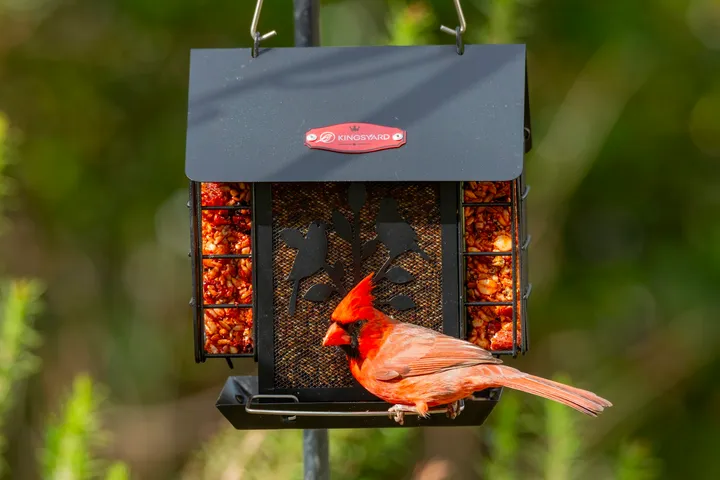
The biggest mistake new cardinal-feeders make is using the wrong feeder type. Cardinals are heavier than chickadees and finches, and their beaks are not built for the narrow perches on standard tube feeders. They need a wide, stable surface to land on.
Platform feeders (best)
A platform feeder (an open tray on a pole or hanging from a tree) is the single best cardinal feeder design. Cardinals can land comfortably, see in all directions (matters for their shy temperament), and access a large surface of seed. A 12 by 16 inch platform with a mesh or screened bottom (for drainage) is the standard. The Woodlink platform bird feeder is the most-recommended platform feeder for cardinals at the $30-50 tier.
Hopper feeders (next best)
A hopper feeder is a covered box with seed dispensing onto a perch tray around the bottom. The perch is wide enough for a cardinal to land, and the covered top keeps the seed dry. The Aspects Quick-Clean hopper feeder or any similar wide-perch hopper works well.
Large-perch tube feeders (acceptable)
If you already own a tube feeder, look at the perches. If they’re small dowels designed for finches, cardinals can’t easily use them. If they’re wraparound or large platform-style perches (more common on modern tube designs), cardinals will manage. The wider the perch, the better the cardinal access.
Feeders to skip for cardinals
- Small-perch tube feeders. The classic nyjer / thistle finch feeder. Cardinals cannot use these.
- Squirrel-proof weight-sensitive feeders calibrated for small birds. A 1.5-ounce cardinal may trigger the weight mechanism designed to exclude squirrels (10+ ounces). Check the calibration before relying on these.
- Window-mount feeders too close to glass. Cardinals are shy and may avoid feeders within a few feet of a window; they also have higher window-strike rates than most species. Either keep window feeders inside 3 feet (where birds can’t build up fatal flight speed) or beyond 30 feet.
Feeder placement: where cardinals actually want it
Placement is what separates yards that see occasional cardinal flyovers from yards that have a breeding pair on the feeder every morning. Three rules:
4 to 5 feet off the ground. Cardinals are not ground feeders by preference, though they will glean fallen seed. A feeder at 4 to 5 feet matches the height where cardinals normally forage in mid-story shrubs.
Within 10 feet of dense cover. Cardinals are jumpy birds. They will not feed in the middle of an open lawn. The feeder should be within a short flight of dense shrubs, a hedge, or a small tree the cardinal can escape into if a hawk shows up. 6 to 10 feet from cover is the sweet spot.
Partly shaded. Morning sun + afternoon shade. Direct afternoon sun accelerates seed spoilage; full shade makes the feeder harder to spot from above.
If your yard is small enough that 10 feet from cover is hard to achieve, prioritize cover over distance. A feeder closer to a shrub is better than a feeder farther from any cover at all.
Water sources cardinals visit
Cardinals visit water 2 to 3 times per day on average per Project FeederWatch citizen-science data. A shallow birdbath (1 to 2 inches deep at the edges) within 15 feet of the feeder is one of the strongest non-food attractants.
Winter consideration: cardinals are year-round residents, but most birdbaths freeze in winter. A heated birdbath (or a simple submersible de-icer in your existing bath) keeps the water liquid. In hard-winter regions (the Upper Midwest, New England), this is probably the single highest-impact upgrade you can make. Cardinals that have an unfrozen winter water source visit yards far more reliably than yards without one.
Cardinals also use moving-water features (drippers, small fountains, misters) readily. A simple drip from a slow-leaking hose nozzle into a shallow dish works as a starter.
Shelter and nesting habitat
Cardinals nest in dense shrubs and low trees 3 to 10 feet off the ground. They build cup nests in the fork of branches, typically well-hidden in foliage. Key habitat features:
- Dense native shrubs, eastern red cedar, holly, dogwood, viburnum, hawthorn, spirea, juniper. The denser the better; cardinals choose nest sites for concealment.
- Evergreens for winter cover, important for year-round residency. Cardinals roost in dense conifers in winter; if you have nowhere they can shelter overnight, they’re less likely to settle in your yard.
- Tangled hedges and brushy edges, cardinals love a “messy” yard with edges, brush piles, and uncleared shrub margins. The Pinterest-perfect manicured lawn is anti-cardinal.
Cardinals do NOT use birdhouses. They are not cavity nesters. A purple martin house, a bluebird box, a chickadee nest cup, none of these matters for cardinals. If you have a yard suitable for cardinals, it has dense shrubs, not boxes.
How to attract cardinals in winter specifically
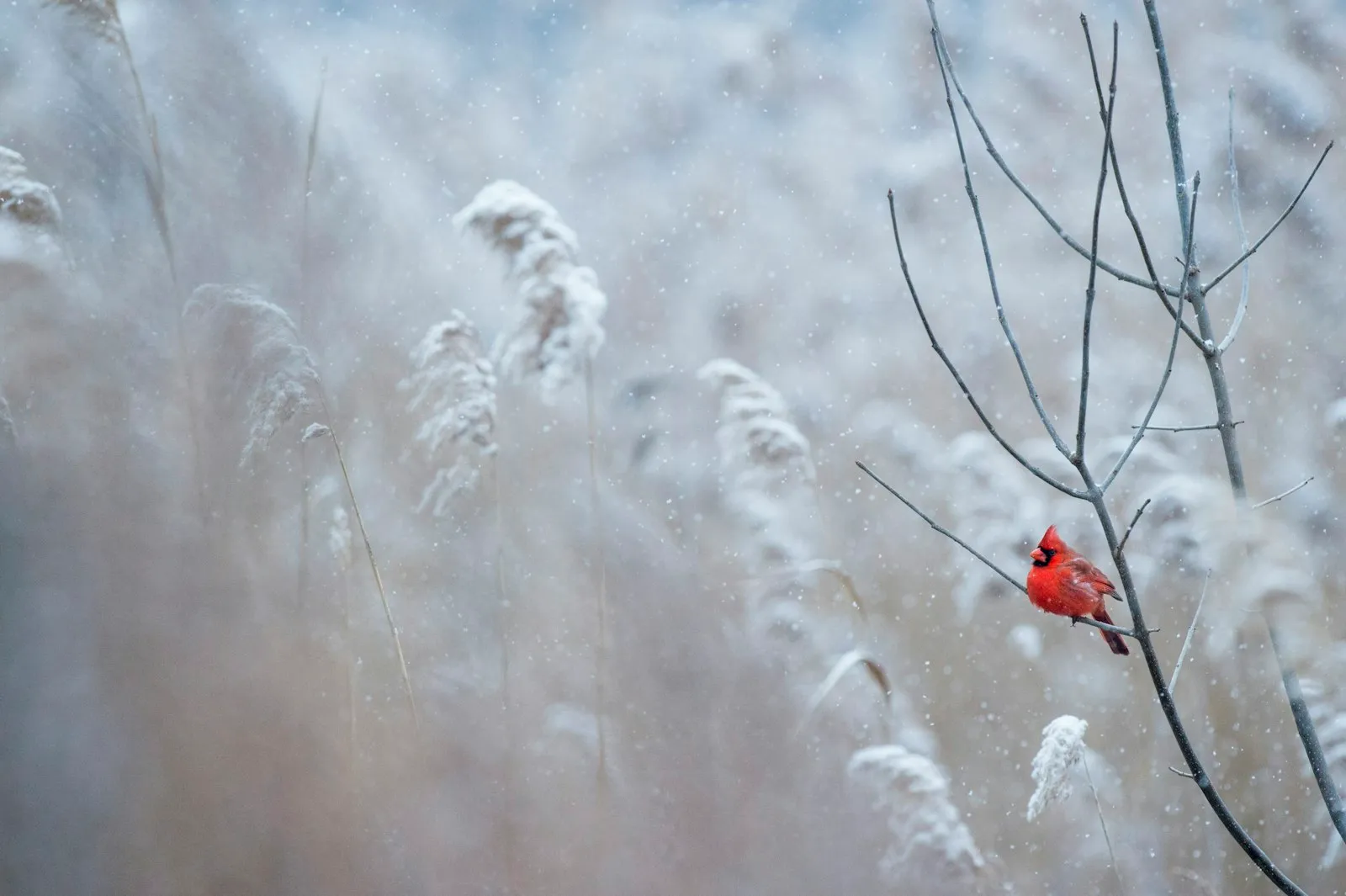
Winter is when cardinals are most visible in most yards: bare deciduous trees reveal them, snow contrasts with their red plumage, and natural food sources are scarcer so they visit feeders more.
The winter playbook:
- Keep the seed feeder full. Don’t let it run empty for more than a day. Winter cardinals depend on feeders far more than summer cardinals.
- Add suet. Fat is critical in winter; suet provides concentrated calories cardinals will eat.
- Heated water source. Worth the $30 to $50 investment. Liquid water is harder to find in winter than food.
- Don’t take feeders down. Some readers worry that feeders cause cardinals to “stay around” when they should migrate. Cardinals don’t migrate, full stop. Take-down advice for migratory birds (hummingbirds, etc.) does not apply.
Audubon’s 10 Fun Facts About the Northern Cardinal covers some of the winter biology including the bright-red plumage’s role in mate selection.
Attracting cardinals AND blue jays
If you’re trying to attract both cardinals and blue jays (a common combination), the setup overlap is strong:
- Peanuts in shell, blue jays love them, cardinals will pick them up too.
- Platform feeders, both species use them comfortably (jays are even larger than cardinals and need the wide surface).
- Black-oil sunflower, universal; both species eat it.
The jay-cardinal differences:
- Jays are louder and more aggressive. They will dominate a feeder when they show up, sometimes scaring cardinals off briefly. The fix is either two feeders (jays prefer the noisy platform, cardinals will use a quieter side feeder) or just accepting the dynamic; cardinals come back once the jays leave.
- Jays cache food. They’ll take peanuts away and bury them. You’ll go through a lot of peanuts with jays around.
A yard set up well for cardinals is automatically pretty well set up for blue jays.
What to skip
- Birdhouses. Cardinals don’t nest in cavities. A birdhouse is irrelevant to them. Plant dense shrubs instead.
- Small-perch tube feeders. Their beak biology doesn’t work with these designs.
- Mostly-millet or mostly-nyjer seed mixes. Cardinals will skip these. Black-oil sunflower or sunflower-heavy mixes only.
- Removing dense shrubs for landscaping. A manicured yard with no dense growth is a cardinal-free yard. Leave the hedges and brushy edges.
- Red dye in seed or water. Red dye matters for hummingbirds (and isn’t recommended even there, per our hummingbird nectar recipe). It’s irrelevant to cardinals. They find feeders by sight and proximity to cover, not by red coloring.
- Loud high-traffic feeder locations. Cardinals are shy. A feeder directly above a deck where you barbecue, or on a fence five feet from the dog’s favorite spot, will get fewer visits than a quieter location.
- Putting a potato in the bird feeder. Folk myth; no real backing from Cornell Lab, Audubon, or Project FeederWatch.
FAQ
What attracts cardinals the most?
Three things, in order: food (black-oil sunflower seed and safflower seed in a wide-perch feeder), water (a shallow birdbath), and cover (dense shrubs or low trees within 10 feet of the feeder). Cardinals are not picky eaters; the food is the easiest part. The setup that wins is placement: 4 to 5 feet off the ground, close to escape cover, partly shaded. Cornell Lab and Audubon both rank cardinals among the easiest backyard birds to attract once those three elements are present.
Where is the best place to put a bird feeder for cardinals?
4 to 5 feet off the ground, within 10 feet of dense shrubs or a small tree, and ideally with morning sun plus afternoon shade. Cardinals will not feed from a feeder exposed in the middle of an open lawn (they need escape cover), but they also won’t approach a feeder buried inside a thicket where they can’t see predators. The sweet spot is the edge of cover: feeder visible from above and from the cardinal’s perch, with thick shrubs 6 to 10 feet away to retreat into.
Why aren’t cardinals coming to my bird feeder?
Most common reasons: (1) the feeder is new and cardinals haven’t found it yet (typical discovery window is 1 to 3 weeks if you have cardinals in your area); (2) the feeder is a small-perch tube design that cardinals can’t physically grip; (3) the feed is mostly millet, nyjer, or seed mix without enough black-oil sunflower; (4) the feeder is too exposed (no shrubs within 10 feet); (5) you’re not in cardinal range (the Pacific Northwest, high Mountain West, and most of Canada have no Northern Cardinals at all). Check the Cornell Lab range map for your area; if cardinals live there, work through the placement and feed first.
Do cardinals migrate or stay year-round?
Northern Cardinals are year-round residents throughout their range. They do not migrate. The same individual cardinals that visit your feeder in summer are still there in winter (in fact they’re more visible in winter, when bare trees and snow make the red plumage easier to spot). Year-round feeding is genuinely useful for cardinals; they rely heavily on backyard feeders in winter when natural seed sources are scarce.
Do cardinals get attached to humans?
No, not in the way pet birds bond with people. Cardinals will recognize you as a reliable food source and may become noticeably less wary when you’re near the feeder (some readers describe a male cardinal that “calls” from a nearby tree when the feeder is empty). They don’t perch on hands, don’t accept hand-feeding except in unusual cases, and don’t form pet-tame bonds. The reliable cardinal-yard relationship is mutual benefit, not attachment.
Why put a potato in the bird feeder?
The “potato in the bird feeder” tip is folk advice that doesn’t really hold up. The claim varies (a baked potato keeps the seed warm, a raw potato keeps water from freezing, etc.). None of these is established practice, and none is recommended by Cornell Lab, Audubon, or Project FeederWatch. If you want to keep water from freezing in winter, use a heated birdbath or a small de-icer designed for the purpose. Skip the potato.
What you can do this weekend
If you’re starting from zero: buy a 10-pound bag of black-oil sunflower seed, a platform or hopper feeder, and a shallow birdbath. Position the feeder 4 to 5 feet off the ground, 10 feet from your densest shrub or hedge. Put the bath nearby. Walk away. Expect the first cardinal within 1 to 3 weeks if you have them in your area. For the broader logic of matching feeder and seed to the species you want, our how to attract birds to a bird feeder pillar covers the universal setup. If you also want fewer squirrels at the feeder, add a safflower seed feeder and read the keep squirrels out of bird feeders article. For hummingbird-specific setup separately, our hummingbird nectar recipe and best hummingbird feeder guide cover that side of the yard. Once cardinals are visiting, our companion guide on what cardinals eat breaks down their full diet by season (and the foods that keep them red), and whether birds can eat bread covers a feeding mistake worth avoiding. And to actually appreciate the detail in a male cardinal’s crest and mask, a decent pair of binoculars helps; our guide to 8x42 vs 10x42 binoculars covers which magnification to choose for backyard birding, and Vortex Diamondback vs Viper compares the two models birders most often choose between.
Sources
- Cornell Lab of Ornithology, All About Birds: Northern Cardinal (range, habitat, biology)
- Cornell Lab of Ornithology, All About Birds: Pyrrhuloxia (the desert cardinal)
- Audubon: How to Attract Northern Cardinals to Your Home (expert-quote-based attract guide)
- Audubon Field Guide: Northern Cardinal (canonical Audubon field guide entry)
- Audubon: 10 Fun Facts About the Northern Cardinal (winter biology, plumage)
- Project FeederWatch (Cornell Lab) (citizen-science observations on cardinal feeder visitation patterns)