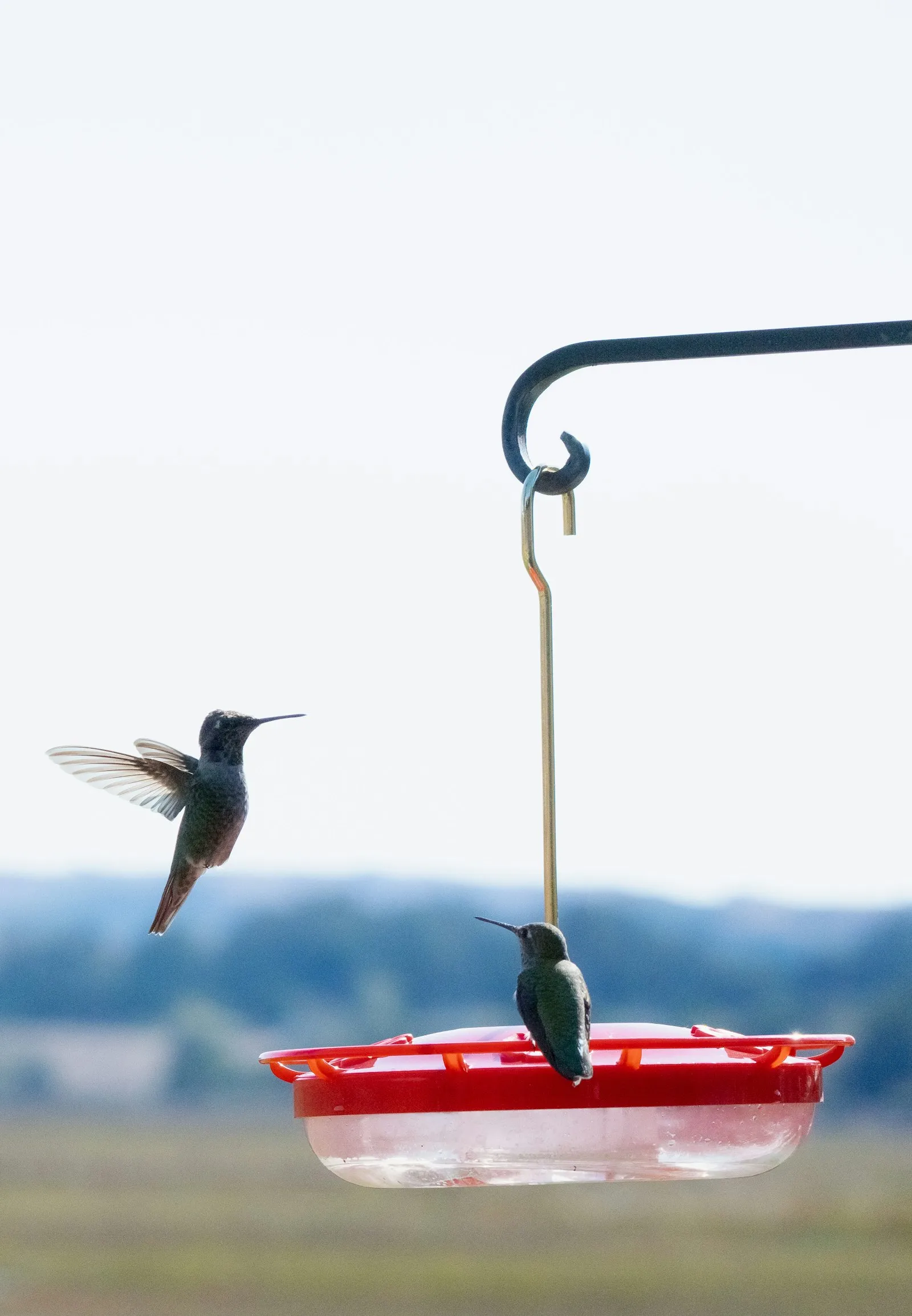
If you see a line of ants marching up the hanger to your hummingbird feeder, or three honeybees crowding the feeding ports while a hummingbird hovers nearby waiting its turn, you have two different problems with two different solutions. Most online guides treat ants and bees as one issue and offer the same five tips for both. They aren’t, and the fixes aren’t interchangeable. Here is how to keep ants out of hummingbird feeder hardware (the answer involves water) and how to keep bees away from hummingbird feeders (the answer involves feeder design), plus the welfare reason this matters more than competitors usually mention.
Quick answer
Ants and bees need different solutions because they reach the feeder differently. For ants, use an ant moat: a small cup of water above the feeder that ants cannot cross. For bees, switch to a saucer-style feeder where the nectar sits below the ports out of bee reach, or fit bee guards over the ports of a bottle feeder. Move the feeder 5 to 10 feet every 1 to 2 weeks to disrupt both. Never use petroleum jelly or insecticide near a hummingbird feeder; both are fatal to hummingbirds.
Why ants and bees need different solutions
The mental model that fixes both problems is simple: ants walk, bees fly.
Ants reach the feeder by climbing. They follow a pheromone trail up the deck post, along the eaves of the house, down the hanger, and into the feeder ports. Block the climb, block the ants. Every effective ant fix is some version of “make the climb impossible” (an ant moat is a moat; fishing line is a high-wire; periodic relocation invalidates the pheromone trail).
Bees reach the feeder by flying. The hanger is irrelevant. Bees orient to the feeder by sight (the red color, especially) and by scent (the sugar fermenting in heat). Every effective bee fix is some version of “make the ports unreachable for bee mouthparts” (saucer feeders, bee guards) or “make the feeder less attractive than the alternatives” (shade, alternative flowers in the yard, no leaking).
Once you see ant-defense as a vertical-axis problem and bee-defense as a horizontal-axis problem, the rest is mechanical.
Why ants in your hummingbird feeder are dangerous, not just annoying
This is the part most “keep ants out of hummingbird feeders” articles skip. Ants in the nectar are not a cosmetic problem.
Ants in sugar water contaminate it in two ways. First, formic acid from ant bodies and excretions changes the nectar’s pH. Second, ants carry bacteria and fungal spores from the soil into the nectar bath. Both accelerate fermentation; fermented nectar in a hot feeder grows the fungus Aspergillus, which causes a fatal tongue infection in hummingbirds. The bird’s tongue swells, the bird cannot feed, and within a few days it dies. Project FeederWatch and Audubon both flag this as the most-common preventable cause of hummingbird mortality at feeders.
Bees are a different story. Bees compete with hummingbirds for the nectar, but they do not contaminate it the way ants do (honeybee mouthparts are mostly nectar-only, not bacterial vectors), and they do not attack hummingbirds. The Perky-Pet article calling bees a “hummingbird predator” is biologically wrong. What bees actually do is crowd the ports until the hummingbird gives up and leaves. The hummingbird does not get hurt; you get to watch fewer of them.
So: ants are a welfare emergency (clean and refresh nectar immediately whenever you find ants in the feeder, per our hummingbird nectar recipe and care guide). Bees are a viewer-experience problem. Different priorities, different solutions.
How to keep ants out of a hummingbird feeder
Five methods, ranked by effectiveness.
Use an ant moat (the single best method)
An ant moat is a small cup, typically 1 to 1.5 inches deep, that sits between the hanger and the feeder. You fill it with plain water. Ants reach the moat, cannot cross water, and turn back. The feeder stays ant-free as long as the moat has water in it.
Two ways to get one:
- Buy one. A standalone ant moat is $5 to $10 at any backyard-bird retailer; the Aspects-brand drip-style screws onto any existing feeder hanger. Some saucer feeders (the Aspects HummZinger Excel, the Perky-Pet 219B) have an ant moat built into the lid.
- DIY one. A small plastic cup, a yogurt lid with a hole punched for the hanger, even a soda bottle cap on the wire above the feeder works. The minimum useful depth is about half an inch; anything shallower evaporates too quickly.
Refill the moat whenever you refill the feeder (every 2 to 3 days in summer heat). If you forget and the moat dries out, the ants return within a day. This is the only ant solution that works in essentially all conditions.
Hang the feeder with fishing line
Replace the metal hanger with 6 to 8 inches of 10-pound monofilament fishing line. The claim is that ants struggle on thin slick line. Results are mixed; some readers report this works, others report ants navigate it fine. It is worth trying as a secondary measure if you already have line on hand, but it is not a substitute for an ant moat.
Move the feeder 5 to 10 feet every 1 to 2 weeks
Ants follow pheromone trails. Once a colony has mapped a route from the nest to your feeder, every worker takes the same path. Relocating the feeder breaks the trail. The colony has to re-scout, which buys you 3 to 7 days of ant-free feeding. Hummingbirds find the new location within a day; they remember the general area and search.
This works best in conjunction with an ant moat, not as a standalone fix.
Keep the feeder clean and leak-free
A cracked plastic feeder or a worn rubber gasket drips nectar down the body and onto the deck below. The drips attract ants by smell from further away. Inspect the feeder every time you clean it. If the seal between the bottle and the base is no longer firm, replace the feeder (most plastic hummingbird feeders last 3 to 4 seasons; glass-bodied ones last decades). For the step-by-step method (and how to clear mold out of the ports), see how to clean a hummingbird feeder; the hummingbird nectar recipe covers the refill schedule by temperature.
What about cinnamon, mint, or vinegar?
Folk remedies. There is no peer-reviewed evidence that any of these repel ants from hummingbird feeders, and no major bird authority (Cornell Lab, Audubon, Project FeederWatch) recommends them. They can also clog feeder ports (cinnamon) or affect a hummingbird’s ability to find the feeder by scent (essential oils). Skip these and use an ant moat instead.
How to keep bees away from hummingbird feeders
Bees are competition for the nectar, not a threat to the birds. The solutions all work by either making the ports physically inaccessible to bees or making the feeder less attractive than alternatives.
Use a saucer-style feeder (the structural fix)
The Aspects HummZinger and similar saucer designs hold the nectar in a flat basin 0.5 to 0.75 inches below the port openings. A hummingbird’s tongue reaches 1.5 to 1.7 inches past the tip of its beak (Cornell Lab’s Anna’s Hummingbird species page covers the anatomy in detail). A honeybee’s tongue maxes out around 0.25 inches. The bee can land on the port, smell the nectar, and physically not reach it.
This is the single most effective bee solution and it requires no maintenance once installed. Saucer feeders also tend to leak less than bottle-style feeders (no gravity-fed gasket to wear out) and are usually easier to clean (the whole basin pops apart). Our best hummingbird feeder guide tiers saucer feeders by budget; the entry-level Aspects HummZinger Mini is around $20 and solves the bee problem on day one.
Fit bee guards over the ports of a bottle feeder
If you already own a bottle feeder and do not want to replace it, bee guards are a $5 to $10 accessory. They are small mesh inserts (plastic or metal) that fit over each feeding port. The mesh openings are wide enough for a hummingbird beak but too narrow for a bee. Most major brands (Perky-Pet, Aspects, First Nature) sell guards sized to fit their feeders. Generic universal-fit guards exist for the more common port sizes.
Bee guards are less effective than a saucer feeder because they only block the ports; bees still cluster on the feeder body and around the moat (if you have one). But they cost less than buying a new feeder.
Move the feeder periodically
Same principle as the ant fix. Bees orient by sight and memory; moving the feeder 5 to 10 feet every 1 to 2 weeks resets their map. Most effective when paired with a saucer feeder or bee guards (alone, the bees relocate to the new spot within a day).
Plant alternative nectar sources in the yard
Bees prefer flowers to feeders when both are available. A small bed of bee-friendly flowers (bee balm, salvia, lavender, oregano in bloom, native asters) 15 to 30 feet from the feeder pulls bees off the feeder body and onto a nectar source that is genuinely better for them. Hummingbirds also benefit because the same plants attract them, and the bees and hummingbirds end up at different parts of the yard. The full plant list is a future Attracting Birds article; for now, any pollinator-friendly native bed works.
Keep the feeder out of direct afternoon sun
Heat accelerates fermentation. Fermentation produces ethanol and volatile compounds (esters, organic acids) that bees can smell from much further away than fresh nectar. A feeder in afternoon sun draws bees in from across the neighborhood; a feeder in partial shade does not. Hang the feeder where it gets morning sun (which attracts hummingbirds by warming the red feeder body) but afternoon shade.
The best hummingbird feeder for both problems
If you want one fix that solves both ants and bees: a saucer-style feeder with an integrated ant moat in the lid. The Aspects HummZinger Excel (about $40) and the Perky-Pet 219B (about $25) are the two most-common models. Both have the saucer geometry that excludes bees and a built-in moat reservoir for the ant fix. You fill the moat when you refill the feeder; the design solves the rest.
For a fuller tier breakdown (saucer, bottle, window-mount, copper, hand-held), the best hummingbird feeder guide covers the picks by use case and budget. The cornerstone takeaway: for ant and bee resistance specifically, saucer beats bottle every time.
What to skip
Common advice that is either ineffective or actively harmful.
- Petroleum jelly or Vaseline on the hanger. Fatal to hummingbirds. If a hummingbird perches on the hanger (they do this routinely), the petroleum jelly sticks to its feathers. The bird cannot preen it off, the feathers lose their thermal and waterproofing function, and the bird dies of cold exposure or starvation. Bird welfare organizations are unanimous on this. Never use it.
- Insecticide sprays near the feeder. Insecticides kill the small insects (gnats, fruit flies, aphids, small spiders) that hummingbirds also eat. Insects make up 30 to 40 percent of a hummingbird’s diet; nectar is just the energy source. Spraying anything near the feeder reduces the prey supply and can poison the hummingbird directly through contact or contaminated water.
- “Take the feeder down for a few days to make the bees leave.” You lose the hummingbirds faster than the bees. Once a feeder has been off for 4 to 5 days, hummingbirds stop checking. The bees come back within hours of you putting it up again.
- Aluminum foil wrapped on the hanger. The myth. There is no good evidence this deters ants, and it can reflect afternoon heat onto a plastic feeder.
- Wider feeder ports. Some readers think bigger ports will let hummingbirds in faster. They also let bees in. Standard port size (around 0.25 inches across) is where the saucer/bee-guard tradeoff is calibrated. Wider is worse for bees.
- Red dye in the nectar. Unrelated to pest control, but worth mentioning while we are listing things to skip. Hummingbirds find feeders by the red of the feeder body, not the nectar color. See our hummingbird nectar recipe for the no-dye reasoning and method.
FAQ
What deters ants from hummingbird feeders?
An ant moat: a small cup of water above the feeder that ants cannot walk across. Project FeederWatch and Audubon both recommend this as the primary method. Fishing line as the hanger is a weaker secondary measure (ants reportedly struggle on monofilament, though results vary). Cinnamon, mint, and vinegar are folk remedies with no scientific support. Do not use Vaseline or petroleum jelly on the hanger; it sticks to hummingbird feathers and is fatal.
Why do you put aluminum foil on hummingbird feeders?
Some people wrap aluminum foil around the feeder hanger or pole as an ant deterrent, the theory being that the slick reflective surface is hard for ants to walk on. The evidence is anecdotal at best, and foil can disorient hummingbirds or reflect heat onto plastic feeders. An ant moat works far better, costs less, and has actual citizen-science backing.
What repels ants but not hummingbirds?
Water. A water-filled ant moat is the only chemical-free method that reliably blocks ants without affecting hummingbirds. Hummingbirds fly to the feeder ports and never touch the moat. Scent-based repellents (cinnamon, mint oil, peppermint oil) are unreliable on ants and can potentially affect hummingbirds’ ability to find the feeder by smell, so they are not recommended.
What repels bees but not hummingbirds?
Structural mismatch, not chemicals. Saucer-style feeders hold nectar 0.5 inches below the port; hummingbird tongues reach 1.5 to 1.7 inches, but honeybee tongues max out around 0.25 inches. The bees cannot physically reach the nectar. Bee guards (small mesh inserts over bottle-feeder ports) achieve the same thing on bottle designs. Avoid any oil or spray on the feeder body, as both attract dirt and can stick to hummingbird feathers.
Does cinnamon keep ants or bees away from hummingbird feeders?
There is no peer-reviewed evidence that cinnamon repels either ants or bees from hummingbird feeders. The claim circulates in gardening blogs, but neither Cornell Lab, Audubon, nor Project FeederWatch recommends it. Cinnamon can also clog feeder ports and might affect a hummingbird’s sense of smell at close range. Use an ant moat for ants and a saucer feeder or bee guards for bees.
What is a hummingbird’s worst enemy?
Free-roaming domestic cats and window collisions, by a wide margin (covered in our state-by-state hummingbird feeder timing guide). Ants and bees are nuisances, not threats. The thing that hurts a hummingbird is not the pest itself but a dirty or fermented feeder, which causes a fatal tongue fungus called Aspergillus. Keep the nectar fresh and the feeder clean; the pests are a downstream problem.
What you can do today
If you have ants: add an ant moat to the hanger this afternoon. It is the single highest-leverage thing you can do for this problem, and it costs less than $10. If you have bees: order a saucer-style feeder, or if you want to keep your current bottle feeder, fit bee guards over the ports. Either way, refresh your nectar (it is almost certainly contaminated if pests have been at it) using the 4:1 nectar recipe, check that your feeder is up at the right time for your region in our state-by-state guide, and consider whether your current feeder is doing the job at all in the best hummingbird feeder tier breakdown.
If you are still waiting on your first visitors, our 7-day plan for attracting hummingbirds covers placement and patience, and the hummingbird migration guide explains when to expect them in your region.
Sources
- Cornell Lab of Ornithology, All About Birds: Ruby-throated Hummingbird, Anna’s Hummingbird (tongue length, diet composition)
- Audubon: Hummingbird Feeding FAQs (mold, fermentation, cleaning cadence)
- Audubon: The Audubon Guide to Attracting Hummingbirds and Orioles (feeder placement, pest management)
- Project FeederWatch (Cornell Lab) (citizen-science backyard observations on feeder hygiene and pest interactions)